
Python 3.15 Stable Release: New Features and JIT Upgrades
On October 9 local time, developers officially launched the Python 3.15.0 stable version. This major update introduces numerous novel features and profound performance enhancements. Furthermore, the release represents a monumental collaborative effort. It culminates 5,643 individual code commits from 1,012 dedicated contributors worldwide. Developers can securely acquire the software via the official Python downloads page.
Major Interpreter Enhancements
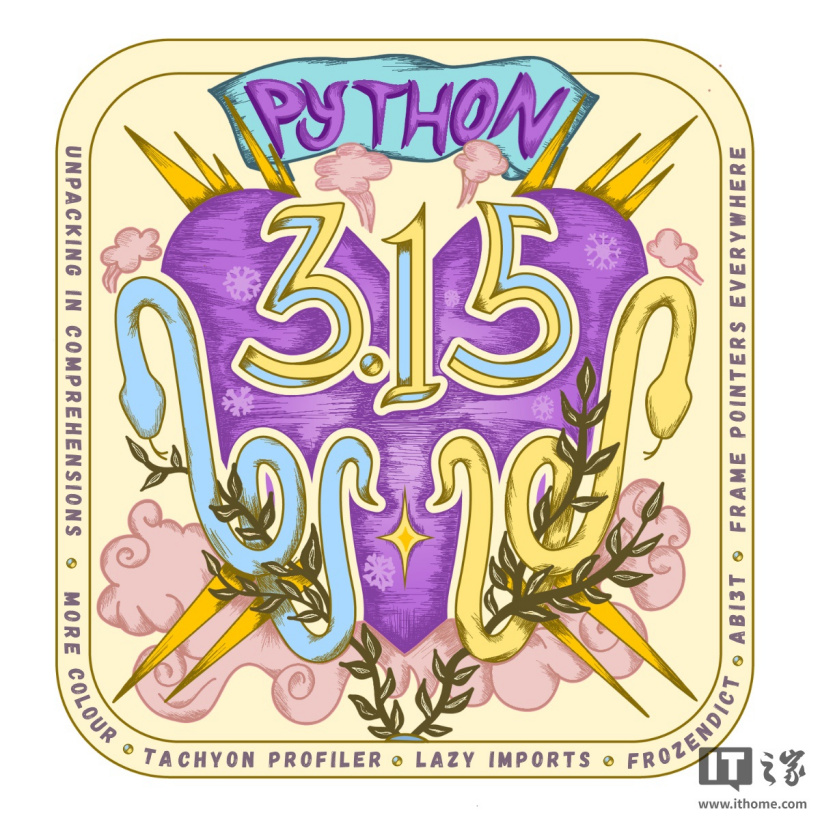
Python 3.15 delivers substantial architectural upgrades. First, PEP 661 introduces a built-in sentinel type. Second, under PEP 686, Python now utilizes UTF-8 encoding by default. Moreover, PEP 798 enables elegant unpacking operations within comprehensions. Consequently, PEP 810 introduces explicit lazy imports to reduce startup times significantly. Additionally, PEP 814 adds an immutable dictionary built-in type called frozendict. Finally, PEP 829 supports package-level startup configuration files.
Experimental JIT Compiler Upgrades
The experimental Just-In-Time (JIT) compiler receives remarkable improvements. On x86-64 Linux platforms, it achieves a 7 to 8 percent performance boost over the standard interpreter. Meanwhile, on AArch64 macOS systems, execution speeds accelerate by 11 to 12 percent compared to the tail-calling interpreter. Furthermore, developers will notice highly optimized error messages.
Standard Library and Tooling Updates
The standard library features several critical updates. Notably, PEP 799 introduces a dedicated performance analysis toolkit. Therefore, developers can seamlessly manage various profiling tools. It also incorporates the Tachyon high-frequency statistical sampling profiler. Additionally, terminal outputs and error messages now feature expansive color highlighting. Users can explore all functional changes in the Python 3.15 update documentation.
Advanced Type System Capabilities
The typing system gains sophisticated new mechanisms. Specifically, PEP 728 allows developers to specify types for extra items within a TypedDict. Similarly, PEP 747 supports utilizing TypeForm to annotate the shape of types themselves. Finally, PEP 800 establishes a disjoint bases mechanism within the type system.
Evolving C API Interfaces
The C API interface introduces several robust enhancements. PEP 782 delivers the PyBytesWriter C API for crafting Python byte objects. Furthermore, PEP 788 integrates protective measures against premature object finalization. Consequently, PEP 803, 820, and 793 establish a stable Application Binary Interface (ABI). These proposals provide vital C APIs for free-threaded builds without the global interpreter lock.
Build Configuration and Official Packages
Under PEP 831, the system now enables frame pointers by default. As a result, this change vastly augments system-level observability and performance diagnostic capabilities. Ultimately, official release packages feature notable default alterations. The Windows 64-bit official pre-compiled binary package now employs the tail-calling interpreter by default. Likewise, the macOS official pre-compiled binary package defaults to installing free-threading support.