
A Microsoft patent application describes an AI system that could swap the words a person says on a live stream before viewers hear them. It would also redraw the speaker’s lips so the new words look natural. According to the patent tracker Patentlyze, which first flagged the Microsoft filing, the edited feed would run about 1 to 10 seconds behind the live event.
The filing is not a granted patent. A US patent examiner rejected the claims as filed in a first review, and Microsoft can still respond. Even so, the document gives a detailed look at how live video could be edited for each viewer.
What the Microsoft patent application covers
The application is titled “Near Real-Time Artificial Intelligence (AI) Enhancement of Video or Augmented Reality (AR) Presentations of Live Events.” It carries publication number US 2026/0341309 A1 and was published by the US Patent and Trademark Office on October 29, 2026. Microsoft Technology Licensing filed it on April 29, 2025. Patentlyze lists David Callaghan and Dinesh Kumar as the inventors.
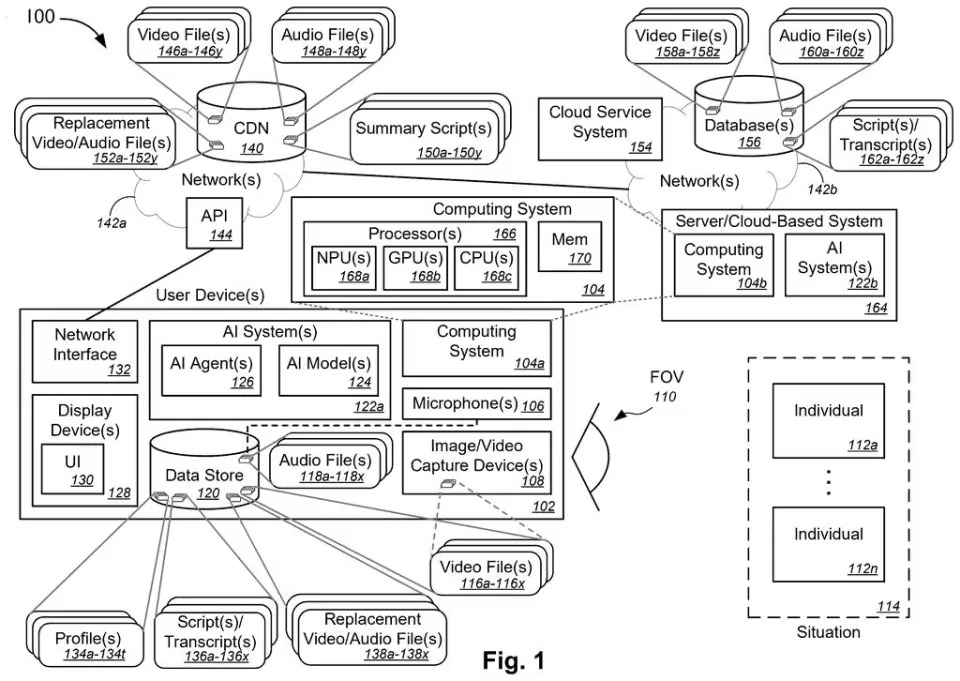
The system pairs two pieces. An AI agent listens to the live audio and picks out words to change or remove. A generative AI system then replaces those words in both the audio and the video.
The agent makes its choices based on set rules or a viewer’s profile. Patentlyze says that profile can include the viewer’s age, the languages they speak and where they live. In other words, two people watching the same event could hear different versions of it.
What the AI could change
The examples in the filing go well beyond removing an “um.” Futurism’s report on the patent and Patentlyze describe several kinds of edits.
| Type of edit | Examples from the filing |
|---|---|
| Verbal tics | Filler words such as “um” or “ah,” stutters and speech impediments |
| Speech errors | Mumbled, mispronounced or misused words |
| Wording a viewer may object to | Offensive, insensitive or inappropriate words |
| Personal style | Slang, coined terms and colloquialisms such as “y’all” and “bite the bullet” |
| Language | Speech in a language missing from the viewer’s profile, replaced with a translation |
| Audio clean-up | Background noise, according to Patentlyze |
Replacement words could come from an “internet search,” both outlets report. Patentlyze adds that the filing floats instant fact-checking as one possible use.
The filing lists live content such as lectures, presentations, award shows, game and cooking shows, and live sports. Patentlyze says the system could run on AR glasses, phones, tablets or video cameras, using chips on the device.
What changes for viewers and speakers
For viewers, the clearest benefit is translation. A speaker could appear to talk in the viewer’s own language, with matching mouth movements. Cleaner speech without stutters or filler words is another stated goal.
For speakers, the picture is less simple. The system could change their words, and the redrawn lips would hide the change. That is why the filing has drawn comparisons to deepfakes.
Futurism argued that this goes further than switching off a broadcast you dislike. Viewers could alter someone else’s speech to fit their own tastes. The outlet warned this could push people deeper into personalized bubbles. It also asked, “What’s so bad about hearing someone from the South say ‘y’all?’”
One safeguard does appear in the filing. A dependent claim keeps the original live recording as “ground truth.” Patentlyze notes that only this later claim preserves the original, while the broad first claim covers filler clean-up, politeness filtering and fact swaps alike.
Where the filing stands
- April 29, 2025: Microsoft files the application.
- July 29, 2026: The examiner issues a first review that rejects the claims as filed.
- September 14, 2026: Microsoft publishes a draft Code of Conduct for its AI models, opening a six-week public consultation.
- October 29, 2026: The USPTO publishes the application.
Patentlyze calls a first rejection routine. Applicants usually answer it with amendments. A published application only shows what a company wants to protect. It does not show that a product is coming.
Technical details: how the edit works
The broad first claim covers four steps. The system scans live audio, chooses words to modify based on a user profile, generates replacements in audio and video, and smooths the seams. Futurism notes that the system edits the audio and video just before and after each changed word for “smooth transitions.”
Translation sits in a separate independent claim. Patentlyze places it at claim 16 and calls it narrower. The application has 20 claims and 11 drawing sheets. Those drawings also cover transcript-based editing of recorded speech and condensing recordings into summary videos.
The short delay is what makes the edits possible. Holding the feed back by up to 10 seconds gives the AI time to rewrite a phrase and render new lip movements before viewers see it.
Open questions
Microsoft did not immediately respond to Futurism’s request for comment. It has not said whether it plans to build the system or put it in any product.
Several points remain unclear from the reports. Would viewers know they are watching an edited feed? Would speakers have to agree to changes to their words? Who could access the “ground truth” recording?
These questions matter because of Microsoft’s own stated rules. Its draft Code of Conduct for AI models says models “will not generate or facilitate” deceptive impersonation or malicious deepfakes. How a live speech editor would fit those limits is something to watch if the idea ever moves past the patent office.