Apple Watch Sleep Apnea Notifications Roll Out Following Medical Approval
Apple officially rolled out its latest over-the-air software updates at 1:00 AM on October 14. After upgrading to the newest versions of iOS and watchOS, Apple Watch users in China can finally activate sleep apnea notifications. Having previously secured approval from China’s National Medical Products Administration (NMPA) as a Class II medical device, the feature joins a growing suite of regulated clinical tools on the wearable.
Currently, sleep apnea detection supports Apple Watch Series 9, Apple Watch Ultra 2, Apple Watch SE 3, and subsequent models. Furthermore, the feature specifically targets adult users aged 18 and older who have not yet received a formal sleep apnea diagnosis.
Now in its eleventh year on the market, the Apple Watch spans 18 distinct health categories, with sleep tracking serving as a foundational pillar. From bedtime reminders and sleep stages to sleep scoring and vital signs monitoring, Apple has steadily transformed the timepiece into an intimate nocturnal observer. Consequently, adding sleep apnea detection shifts user focus from merely sleeping well to sleeping healthily.
Eighty Percent of Patients Remain Undiagnosed
A pervasive misconception suggests that loud snoring indicates deep, restful slumber. In reality, after a person falls asleep, soft pharyngeal tissues and a relaxed tongue can obstruct the upper airway. A complete airflow interruption lasting more than 10 seconds constitutes an apnea event. Meanwhile, a partial blockage that significantly reduces airflow and lowers blood oxygen levels is known as hypopnea. Medically termed obstructive sleep apnea-hypopnea syndrome, the condition is diagnosed when the Apnea-Hypopnea Index (AHI) reaches or exceeds five events per hour.
Notably, its prevalence far exceeds public perception. A 2019 study published in The Lancet Respiratory Medicine revealed that global prevalence surged from 2%-4% over a decade ago to more than 24%. Today, over one billion individuals aged 30 to 69 suffer from the disorder worldwide, while China leads globally with approximately 176 million patients.
Even more concerning is the massive diagnostic gap, as roughly 80% of sufferers remain entirely unaware of their condition. Although obesity and a thick neck represent primary risk factors, anatomical traits such as a small jaw, deviated nasal septum, enlarged tonsils, or macroglossia place many slender individuals at risk. Some patients even present primarily with insomnia or anxiety.
Every apnea episode triggers hypoxia and carbon dioxide retention, while repeated micro-arousals fragment sleep architecture. Additionally, violent intrathoracic pressure fluctuations continuously strain the heart and blood vessels. Clinical data shared by Apple indicates that roughly 80% of resistant hypertension cases correlate with sleep apnea. Moreover, the condition increases coronary heart disease risk fivefold, appears in 60% to 90% of stroke patients, accounts for 46% of sudden nocturnal cardiac deaths, and raises motor vehicle accident risk sevenfold.
Detecting Respiration Through Subtle Wrist Movements
Rather than relying on traditional blood oxygen monitoring, Apple Watch takes a mechanical approach. Starting with Series 9, the wearable’s upgraded silicon and high-dynamic-range accelerometer measure forces up to 256g. When worn overnight, the sensor captures microscopic wrist tremors invisibly triggered by respiratory muscle effort. Using these vibrations, the watch identifies abnormal breathing patterns and calculates a new metric called Breathing Disturbances, measured in events per hour.
Why bypass blood oxygen sensors? Apple explains that after evaluating multiple data streams, engineers determined the accelerometer alone could achieve clinical targets. Conversely, pulse oximetry operates intermittently and might miss individual respiratory events.
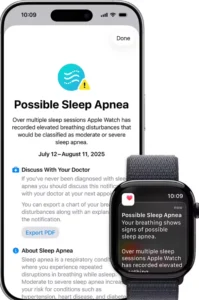
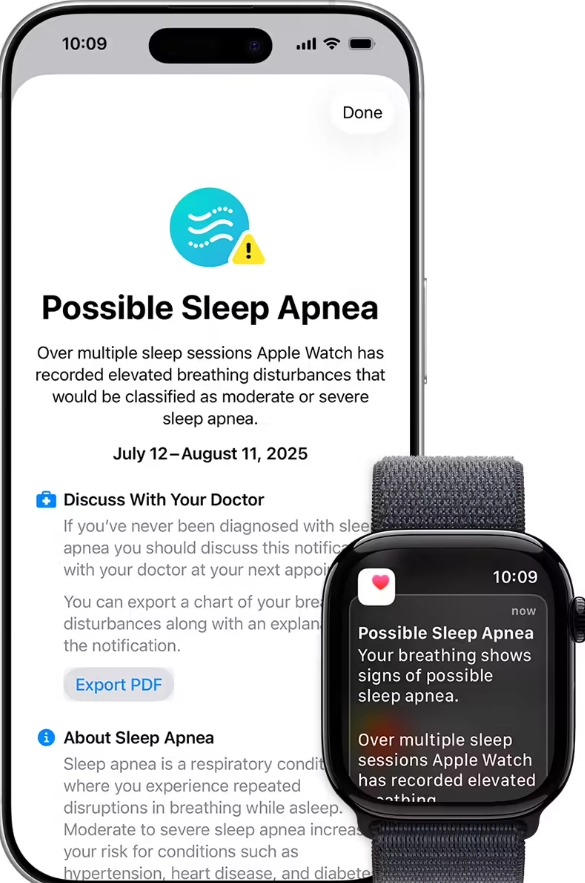
In practice, the algorithm evaluates data across a 30-day window. Users must wear the watch for at least 10 nights within that period, though the nights need not be consecutive. If more than half of those recorded nights show elevated breathing disturbances, the Apple Watch issues an alert indicating potential moderate-to-severe sleep apnea. If fewer than 10 nights are logged, the system remains silent.
Because sleep apnea is a chronic condition rather than an acute emergency, Apple notes that a 30-day observation window ensures rigorous screening. Factors such as alcohol consumption, upper respiratory infections, medications, exercise, and weight fluctuations can temporarily elevate disturbance levels, all of which appear on the Health app timeline.
To train the algorithm, Apple utilized over 11,000 nights of paired clinical data. Participants wore an Apple Watch while undergoing hospital-grade polysomnography (PSG) or Home Sleep Apnea Testing (HSAT). Furthermore, researchers applied a strict 4% blood oxygen desaturation threshold to minimize false positives. In clinical validation involving nearly 1,500 subjects over 30 nights, the feature achieved 66.3% sensitivity and 98.5% specificity. Remarkably, zero healthy participants received a false alarm, while sensitivity among severe cases reached 89.1%.
Screening Thresholds, Privacy, and Clinical Impact
Apple repeatedly emphasizes that this tool provides a risk notification rather than a medical diagnosis, treatment, or management plan. Even if no alert appears after 30 days, users should not completely rule out respiratory issues. However, if a notification arrives, Apple advises consulting a physician promptly and exporting the Breathing Disturbances PDF report from the Health app.
For instance, an Apple employee who enabled the feature during a business trip in the United States received an alert after 30 days. A subsequent medical exam confirmed severe sleep apnea caused by nasal structure issues that obstructed breathing when lying on one side. After starting continuous positive airway pressure (CPAP) therapy, his sleep metrics stabilized, and his doctor noted how rare it was to catch the condition before cardiac complications developed. For privacy, all health metrics remain encrypted on the device and in iCloud.
Ultimately, traditional polysomnography requires overnight hospital stays and dedicated technicians, making it insufficient for screening hundreds of millions of potential patients. By moving initial screening to the wrist across multiple nights, the Apple Watch bridges a critical healthcare gap and guides undiagnosed individuals toward proper medical care.