
Critical 16-Year-Old UEFI Firmware Vulnerability Uncovered
A dormant UEFI firmware vulnerability, which has remained undetected for approximately sixteen years, has recently been exposed to the public. Tracked officially as CVE-2026-97631, this critical security flaw commands a near-perfect CVSS 4.0 severity score of 9.5 out of a maximum 10. As reported by cyber security analysts at The Hacker News, the vulnerability resides deep within the Preboot Execution Environment (PXE) network boot driver of TianoCore EDK II, a widely adopted open-source UEFI reference implementation. Under specific conditions, malicious actors can exploit this weakness to execute arbitrary code before the host operating system even begins to load, thereby compromising servers and various enterprise devices that depend on these foundational components.
The Mechanics of the Network Boot Exploit
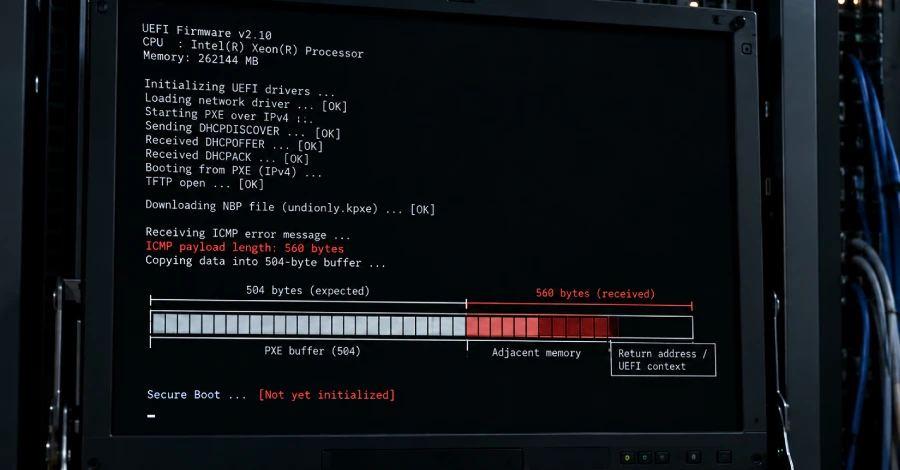
According to a security bulletin published by TianoCore on October 22, this profound vulnerability stems directly from how the EDK II PXE Base Code driver processes Internet Control Message Protocol (ICMP) error messages. Specifically, the software suffers from an out-of-bounds write defect. The vulnerable routine attempts to copy incoming network data into a statically allocated 504-byte memory buffer. However, it critically fails to validate and restrict the length of the copied data. Consequently, a remote attacker can transmit an excessively large, specially crafted ICMP error packet to overwrite adjacent memory regions, effectively triggering a devastating buffer overflow.
Remarkably, tracing the source code reveals that this flawed implementation was introduced around 2010. For over a decade and a half, the vulnerability has silently persisted across countless deployments. An attacker can initiate the exploit sequence by targeting a device precisely when it attempts a PXE network boot. A successful intrusion allows the perpetrator to hijack the execution flow entirely. Even if the attacker fails to achieve full arbitrary code execution, the oversized packet will inevitably corrupt the boot sequence, causing the target system to crash or halt indefinitely.
Why Pre-Boot Vulnerabilities Are Highly Dangerous
The most alarming aspect of CVE-2026-97631 is its pre-boot operational theater. Because the attack unfolds before the operating system and its associated security software are initialized, traditional endpoint protections are entirely blind to the intrusion. Furthermore, the malicious payload could potentially execute before fundamental firmware security protocols, such as Secure Boot and Measured Boot, have the opportunity to validate the system state. Therefore, administrators cannot rely exclusively on these conventional cryptographic safeguards to repel such low-level network attacks. However, achieving reliable code execution does require the attacker to precisely tailor their exploit to the specific firmware environment of the target machine; merely broadcasting the malformed packet will not guarantee automatic control.
It is crucial to understand the vast reach of TianoCore EDK II. This open-source framework serves as the bedrock for UEFI firmware constructed by major industry suppliers, including AMI, Insyde, and Phoenix Technologies. Additionally, Microsoft incorporates these core components into its Project Mu initiative. Consequently, the blast radius of this vulnerability spans a multitude of hardware vendors and server ecosystems. The actual susceptibility of a given machine depends on its specific firmware revision, its component configuration, and whether the PXE network boot feature is actively enabled in the BIOS settings.
Mitigation and Patch Availability
Fortunately, this vulnerability does not mean every server connected to the internet is in immediate peril. The threat model requires the attacker to be positioned on the same network segment to intercept and respond during the brief window of a PXE boot. If a server is configured to boot exclusively from a local hard drive or solid-state drive, and the network boot stack is completely disabled, the system remains immune to this specific vector.
On a positive note, the TianoCore development team swiftly addressed the root cause, merging a comprehensive patch into the upstream main branch of the EDK II repository on October 15. Nevertheless, as of this writing, the vital fix has not yet trickled down into stable production releases. In the enterprise Linux sphere, Red Hat has issued a security advisory confirming that the edk2 software packages embedded within RHEL 8, RHEL 9, and RHEL 10 are indeed vulnerable. System administrators must vigilantly monitor their respective hardware vendors and operating system providers for forthcoming firmware updates to permanently eradicate this deeply rooted flaw.