
Nvidia RTX 30 Series Unleashes Hidden AI Potential
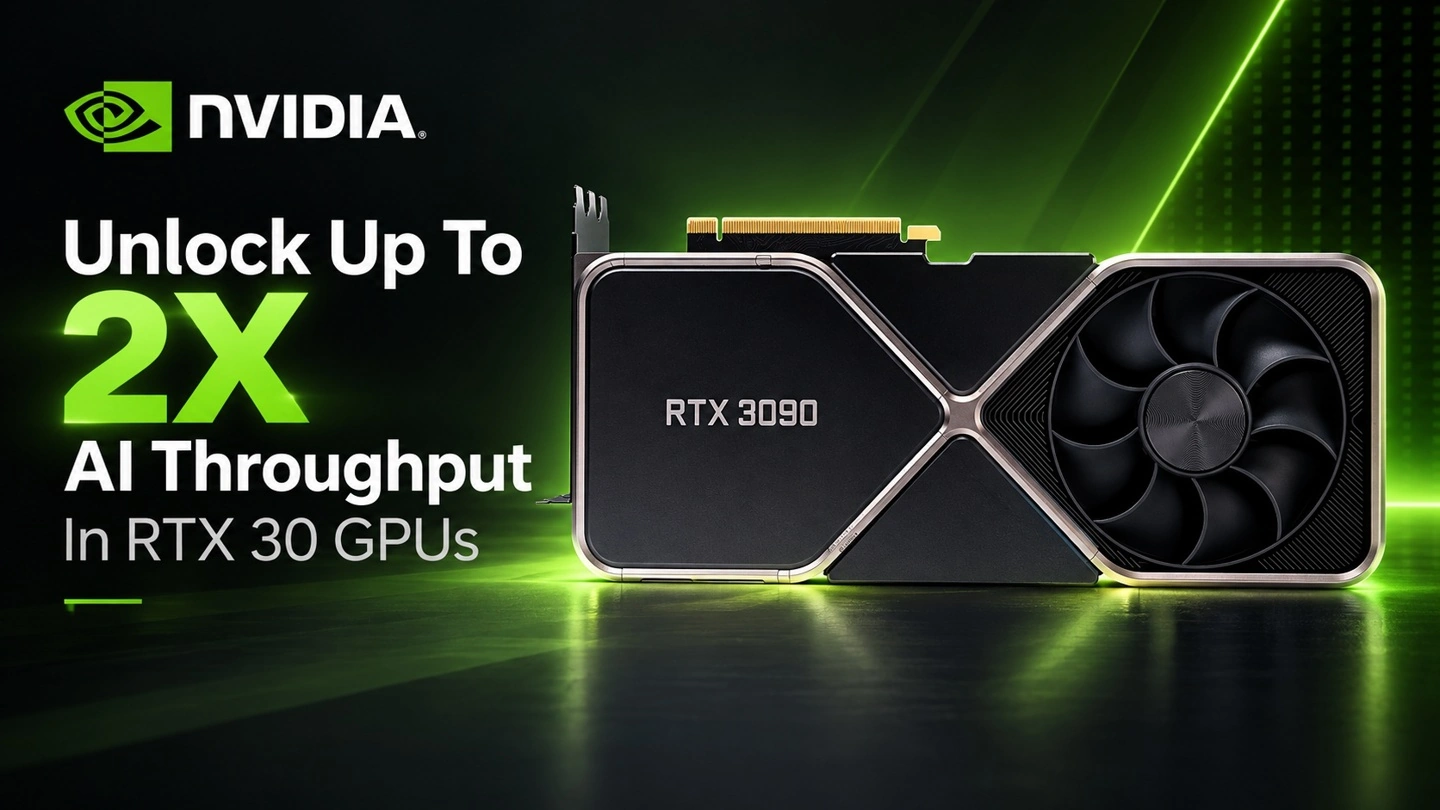
The Nvidia GeForce RTX 30 series boasts the powerful Ampere architecture. These cards have existed on the market for quite some time. Yet, they evidently harbor vast reserves of untapped computational potential. A brilliant developer known as Zagitta recently engineered an ingenious open-source project. They named this innovative software GPU Unlock. Specifically, this utility gracefully circumvents artificial performance limiters on Ampere graphics cards. Under designated workloads, the computational throughput of Tensor Cores can essentially double. Remarkably, this enhancement requires no driver modifications. It also completely avoids permanent VBIOS flashing.
Dismantling Artificial Performance Barriers
This project meticulously targets a specific instruction issue rate limitation. During certain Tensor Core operations, consumer-grade Ampere graphics cards operate noticeably slower. They perform at a lower velocity compared to professional workstation variants. However, dismantling this restriction changes the landscape entirely. In fact, as highlighted in recent hardware coverage, the utility liberates the latent computational prowess of the silicon itself.
Interestingly, GPU Unlock builds upon preliminary research surrounding Nvidia CMP mining accelerators. It elegantly merges firmware unlocking techniques with a pre-initialization strategy. Operating via a Linux kernel module, the software executes maneuvers early. It acts before the official Nvidia graphics driver even loads. This module modifies the corresponding hardware speed selection registers. Next, it performs a crucial Function Level Reset (FLR). Subsequently, the authentic driver can initialize the graphics card seamlessly.
Consequently, users avoid patching the driver with every software update. The developer currently outlines support for several specific silicon variants. These include the GA102, GA103, GA104, and GA106 models. Therefore, the tool encompasses the vast majority of the RTX 30 series portfolio. However, absolute compatibility is not guaranteed for every individual card. Furthermore, performance escalations are not universally assured across all setups.
Substantial Gains in Computational Throughput
The magnitude of these performance enhancements can be quite substantial. The developer published impressive benchmark data on the project’s GitHub repository. For instance, they tested a GeForce RTX 3090 Ti restricted to a 450W power limit. It exhibited remarkable results during specific matrix multiply evaluations.
Moreover, such profound improvements are not exclusively isolated to the flagship RTX 3090 Ti. An RTX 3080 Ti owner reported fantastic results under a 315W power limit. Their BF16 throughput surged from 71.59 TFLOPS to an impressive 113.98 TFLOPS. Simultaneously, TF32 performance ascended from 35.65 TFLOPS to 65.28 TFLOPS. Additionally, a compatibility dossier emerged for the RTX 3080 10GB variant. Under its factory 320W power envelope, performance escalated dramatically. It jumped from approximately 65 TFLOPS to a range of 110 to 113 TFLOPS. Consequently, these empirical findings sparked extensive discourse across various social platforms.
Real-World Artificial Intelligence Benchmarks
How does this translate to practical software applications? Fortunately, the enthusiast community has already commenced evaluating this unlock mechanism. They tested authentic artificial intelligence workloads. Ultimately, these tests yielded highly optimistic preliminary outcomes.
On Reddit, one user conducted extensive benchmarking within ComfyUI. The MOSS-Image SFT BF16 throughput witnessed a 58.6% enhancement. Furthermore, Qwen-Image 2.1 Turbo BF16 climbed by 57.2%. Similarly, Z-Image Turbo BF16 experienced a massive 56.1% boost. Conversely, improvements within the INT8 precision mode remained negligible. For example, MOSS-Image SFT INT8 gained a mere 0.3%. The tester also verified the final visual output. The decoded imagery generated post-unlock remained completely identical to the default state.
Large Language Model (LLM) inference represents another highly anticipated beneficiary. However, the resultant gains depend heavily upon the specific workload topography. For instance, an RTX 3090 compatibility report indicated a 33% increase in prompt processing. It also showed boosted inference throughput. Yet, the actual token generation velocity remained largely stagnant. This phenomenon is logically sound for AI tasks. The primary bottleneck during LLM decoding is frequently memory bandwidth. It is rarely the raw computational throughput of the Tensor Cores.
Experimental Windows Implementations
Another noteworthy advancement is a highly experimental Windows implementation. It abandons the original Linux kernel module entirely. Instead, it favors a complex UEFI-based methodology. The developer documented a triumphant case involving an RTX 3090. In this instance, BF16 computational throughput skyrocketed by approximately 82.5%. Nevertheless, this iteration remains strictly experimental right now. It is tailored exclusively to specific hardware configurations. Therefore, it does not yet constitute a universally applicable Windows release.
Known Tool Limitations
This methodology also harbors explicit technical limitations. GPU Unlock will neither augment memory bandwidth nor unlock dormant CUDA cores. Furthermore, it cannot automatically accelerate every conceivable workload. At least one user provided mixed feedback. They executed a flawless unlocking procedure on an RTX 3080 Ti 20GB. However, the anticipated BF16 performance surge failed to materialize. This anomaly suggests that the efficacy of the tool is not entirely universal.
In the realm of gaming, Nvidia’s DLSS technology similarly leverages Tensor Cores. However, no credible evidence currently suggests gaming benefits. GPU Unlock does not elevate gaming framerates or abbreviate DLSS execution times. Measurable dividends only manifest during highly specific operations. The underlying task must specifically invoke the affected instructions. Therefore, these dazzling computational benchmarks do not equate to a synonymous rise in gaming performance.
Even with these caveats, GPU Unlock remains an intensely captivating endeavor. It appeals strongly to RTX 30 series proprietors. It is especially valuable for those dedicating their hardware to localized AI inference. Image generation and other computationally demanding scenarios benefit greatly. The project remains in its experimental infancy today. Regardless, unearthing substantial latent performance from existing silicon is undeniably alluring. It requires no permanent hardware modifications whatsoever.