Nvidia Launches Open Multimodal Model Nemotron 3.5 Super VL
Nvidia recently announced the launch of a powerful open multimodal model named Nemotron 3.5 Super VL. Engineers specifically designed this AI architecture to power specialized agents. Consequently, it excels at executing complex, multi-step tasks that demand continuous, uninterrupted operation.
The model utilizes an advanced Mixture of Experts (MoE) architecture. It boasts a staggering 120 billion total parameters, with 12 billion functioning as active parameters. According to Nvidia, when executing intensive agent tasks on a single GPU, this model achieves remarkable throughput. In fact, it operates up to five times faster than comparable open models currently available on the market.
Integrating Diverse Capabilities
Impressively, Nemotron 3.5 Super VL seamlessly consolidates multiple crucial capabilities into a single framework. It flawlessly integrates advanced reasoning, precise instruction following, and complex tool-calling abilities. Furthermore, it combines these skills with profound comprehension of text, images, extensive documents, and video content.
Consequently, developers can deploy this versatile tool across numerous demanding scenarios. Typical applications include rigorous code testing, cross-website information retrieval, detailed document analysis, cybersecurity threat identification, and comprehensive video content searching. By leveraging the Nvidia NeMo toolchain, developers can execute specialized post-training procedures. They can seamlessly incorporate their proprietary data, custom tools, internal policies, and unique workflows. Ultimately, this allows them to meticulously tailor the model’s behavior to meet specific business requirements.
Enterprise Customization Success Stories
Nvidia also shared several compelling enterprise customization case studies. For instance, Scale AI, a prominent data technology provider, customized a specialized agent for Skydance Corporation. This agent handles complex vendor credit processing tasks. Experts project that this implementation will slash inference costs for related workloads by an astonishing 97.5%. Simultaneously, it should reduce processing latency by 80%.
Similarly, the financial operations platform Ramp is utilizing the technology to transform receipt images into structured JSON data. This data includes vital merchant details, dates, and payment information. Engineers anticipate a throughput increase of up to 50%, alongside a massive 90% reduction in latency. Furthermore, AI21 collaborated with the cybersecurity firm Alice to create a customized model for threat intelligence and vulnerability analysis. This strategic partnership successfully boosted task accuracy by a remarkable 40%.
Exceptional Benchmark Performance
Regarding official model evaluations, Nvidia reported outstanding benchmark results. Nemotron 3.5 Super VL achieved an impressive score of 80.8% on the rigorous CharXiv chart reasoning benchmark. This significantly surpasses the 63% score achieved by Nemotron 3 Nano Omni. When combined with a Python code interpreter, the new model’s score soared to an exceptional 84%.
During the Hermes Bench and LangChain behavioral assessments, the model scored 63.44% and 87.05%, respectively. These figures comfortably exceed the 56.33% and 84.3% scores recorded by Nemotron 3 Ultra. Nvidia proudly highlighted that this model ranks among the absolute top-performing open models on the competitive OCRBench v2 leaderboard.
Optimizing Inference Efficiency
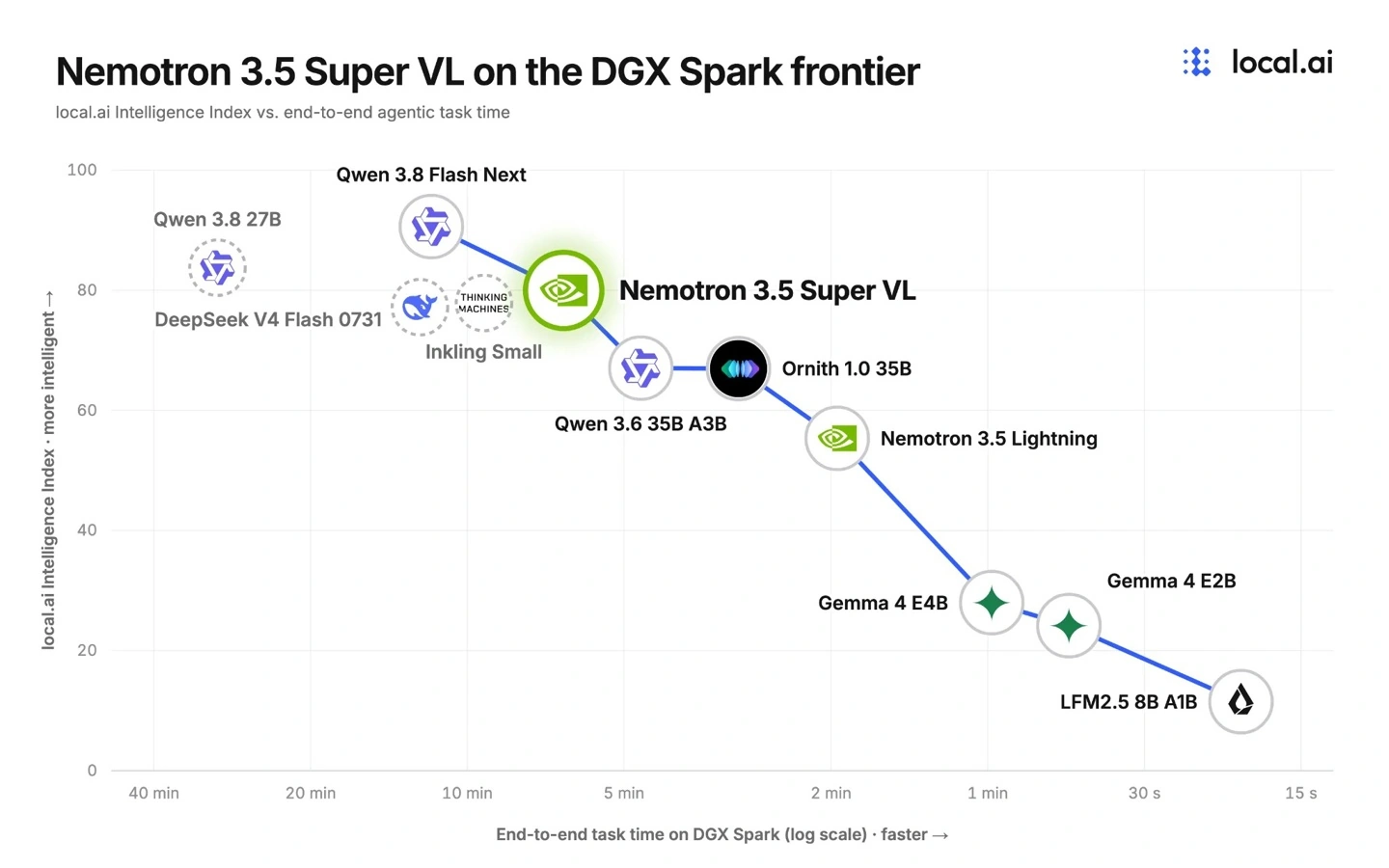
To dramatically reduce inference overhead, Nemotron 3.5 Super VL employs several cutting-edge techniques. These include speculative decoding, mixed-precision processing, and intelligent context multiplexing. Nvidia explained that its proprietary LiLiCorr speculative decoding method yields spectacular results. When running on a DGX Spark system, it accelerates token generation speeds by up to 2.3 times.
Furthermore, the model fully supports NVFP4 quantization. On Nvidia’s revolutionary Blackwell architecture, it utilizes efficient 4-bit weights and 4-bit activation values. Conversely, on non-Blackwell platforms, the identical checkpoint utilizes 4-bit weights paired with 16-bit activation values.
Nvidia also unveiled sophisticated deployment optimization strategies specifically designed for distributed inference. According to their published data, engineers tested the system using sixteen NVIDIA B200 GPUs. Under challenging conditions requiring the generation of 50 tokens per second per user, the results were extraordinary. By utilizing NVIDIA Dynamo in conjunction with cache-aware routing, session affinity, and KV cache offloading, the system achieved massive scalability. It successfully served up to eight times the number of simultaneous users while simultaneously slashing first-token latency by 85%.
This comprehensive release encompasses foundational models, post-training models, and NVFP4 quantized model weights. Furthermore, Nvidia provided extensive training recipes, rich datasets, and robust reinforcement learning environments.
Nvidia revealed that the model processed approximately 26 trillion tokens during its pre-training and continuous pre-training phases. The subsequent post-training phase utilized roughly 3.8 million carefully selected samples. Finally, the model underwent rigorous reinforcement learning across dozens of diverse virtual environments. The newly released datasets cover crucial domains such as agent tool calling, financial reasoning, instruction following, extended context processing, fairness evaluation, and visual-language understanding.
Introducing Nemotron 3.5 Bolt Models
In addition to the massive Super VL model, Nvidia introduced two compact Nemotron 3.5 Bolt models designed for on-device processing. The Nemotron 3.5 Bolt 74B-A9B 24GB utilizes an MoE architecture featuring 74 billion total parameters and 9 billion active parameters. Through innovative native 2-bit quantization, engineers compressed this formidable model down to just 24GB. It targets localized agent tasks and offers robust support for llama.cpp, vLLM, Ollama, Unsloth, and LM Studio. Meanwhile, the ultra-compact Nemotron 3.5 Bolt E4B 4GB targets local voice assistants, interactive digital characters, and embedded interfaces. Nvidia plans to launch this specific variant on October 23.
Currently, both Nemotron 3.5 Super VL and the Bolt 74B-A9B 24GB model are readily available for download. Developers can easily access these valuable resources through popular platforms like Hugging Face, OpenRouter, and ModelScope. Organizations can seamlessly deploy Super VL across diverse environments, including DGX Spark, DGX Station, RTX-equipped systems, enterprise data centers, or cloud infrastructure. The highly anticipated Bolt E4B 4GB model will officially debut on October 23.