
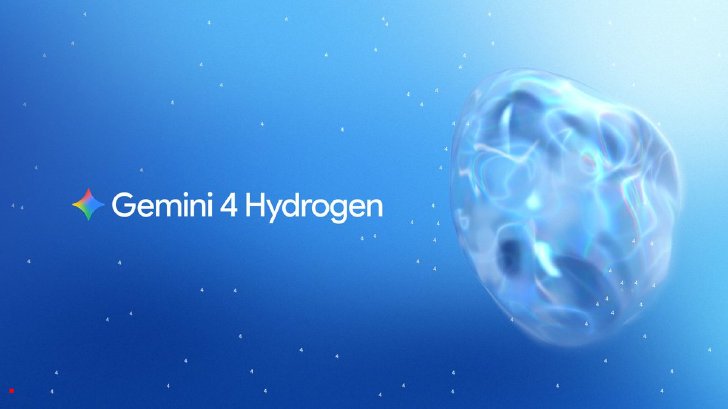
Google’s newest Gemini model costs $1.50 per million input tokens, and it outscores the pricier Gemini 4 Argon on a key intelligence index. Gemini 4 Hydrogen launched on November 12, 2026, and Google says it is rolling out globally. Free Gemini users, Google Search users and developers on the free API tier can all reach it.
Koray Kavukcuoglu, SVP at Google DeepMind and Chief AI Architect, introduced the model in Google’s Gemini 4 Hydrogen announcement. Google calls it “our daily driver for agentic workflows.” Hydrogen is the third model in the Gemini 4 series, after Argon and Carbon. Those two larger models handle deep, long-horizon reasoning. Hydrogen targets fast, everyday coding and agent tasks.
What changes for you
Free Gemini app users
Free users do not get a manual switch to Hydrogen. The Gemini app picks it through auto model selection when it fits the prompt. A footnote in Google’s post adds that most prompts will still use Flash-Lite for quick answers. A free user may therefore see Hydrogen only on some requests.
The model also appears in the Gemini app’s model dropdown. Google says it follows instructions better, calls tools better and handles multi-step tasks more reliably. In the app, it can work with Gmail, Google Drive, Airtable and Dropbox.
Google Search users
Hydrogen now reaches Google Search for all users globally. Google promises better intent understanding, more visual responses and a wider range of relevant links. The company credits an upgraded “query fan-out” technique for the link changes.
Google AI Pro and Ultra subscribers
Paying subscribers get Hydrogen in Google Antigravity, the company’s agent coding tool. Gemini in Google Sheets also starts with Pro and Ultra subscribers, plus eligible business plans. Google says Hydrogen produces Sheets canvas output more than 30% faster than previous models.
Developers and businesses
Developers can call the model as gemini-4-hydrogen in the Gemini API and Google AI Studio, on all tiers. The free tier costs nothing but has rate limits, according to the Gemini API guide for Hydrogen. The model is also available in Android Studio. Businesses can use it through Gemini for business, by API or from a model dropdown.
How the price compares with Argon and Carbon
Hydrogen costs $1.50 per million input tokens and $7.50 per million output tokens. The output price includes thinking tokens. Google charges the same rate across the full context window. Cached input costs $0.075 per million tokens, a 95% discount.
Argon and Carbon cost more, and their prices are about to double. Both sell at an introductory $2 for input and $10 for output. That period ends on November 30, 2026. The public versions then move to $4 and $20, according to Google’s Gemini 4 Argon launch post and its Gemini 4 Carbon announcement.
| Model (per 1M tokens) | Input | Output |
|---|---|---|
| Gemini 4 Hydrogen | $1.50 | $7.50 |
| Gemini 4 Argon or Carbon, until Nov 30 | $2 | $10 |
| Gemini 4 Argon or Carbon, from Dec 1 | $4 | $20 |
For teams on Argon, the trade looks easy to test. Hydrogen scores 51 on the Artificial Analysis Intelligence Index at its default setting, while Argon scores 50. From December, Argon’s output tokens will cost more than 2.5 times as much. The Decoder went further. It noted that Google had recommended Argon for daily coding just two days earlier, and called Argon “obsolete less than four weeks after its release.”
Benchmarks: where Hydrogen leads and where Claude wins
Google compared Hydrogen with Anthropic’s Claude Sonnet 5.5 and OpenAI’s GPT-6.1 Terra on ten tests. Hydrogen led on seven. Claude Sonnet 5.5 led on the other three, which cover terminal coding, computer use and terminal-based science tasks. Google published the scores as a chart image. The figures below follow the transcription by Fello AI.
| Benchmark | Gemini 4 Hydrogen | Claude Sonnet 5.5 | GPT-6.1 Terra |
|---|---|---|---|
| SWE-sweep | 13.5% | 3.1% | 5.8% |
| Terminal-Bench 4.1 | 57.0% | 63.9% | not reported |
| Agents’ Last Exam v1.1 | 71.6% | 60.4% | 69.8% |
| AutomationBench-AA | 76.1% | 71.8% | 60.2% |
| Vending-Bench 2 | $14,549 | $11,165 | $9,107 |
| OSWorld-2.1 | 77.6% | 83.9% | 74.2% |
| MKA (multimodal) | 53.4% | 52.0% | 43.8% |
| Chartography | 66.6% | 61.6% | 63.2% |
| Terminal-Bench-Science 0.1 | 51.4% | 59.9% | 58.3% |
| HLE-Diamond | 58.8% | 53.3% | 47.3% |
Read these numbers with care. Google’s evaluation methodology document says most rival figures are the providers’ own reported results. Google ran some tests itself, such as Hydrogen and Sonnet 5.5 on OSWorld-2.1. It used the maximum available reasoning settings for the rival models.
The independent leaderboard view is closer. The Decoder, citing Artificial Analysis, reports that Claude Sonnet 5.5 and GPT-6.1 Sol each score 55 at maximum thinking. Hydrogen reaches 54 at its new xhigh level. On Terminal-Bench 4.0, Sonnet 5.5 scored 64% and Hydrogen 54%, per the same report.
Google’s other performance claims
- Hydrogen finishes tasks about 2.5 times faster than Gemini 3.8 Flash at the default setting.
- It scores 57% on Terminal-Bench 4.1, against 18.2% for Gemini 3.8 Flash.
- It makes more than five times fewer fabricated claims than Gemini 3.8 Flash.
- Partner tests on graphs, SQL and data-heavy work ran 2 to 2.8 times faster, with 12% to 23% fewer tokens.
- It ranks fifth on Agent Arena and first overall on the Vals Tax Agent Bench, at 52.3%.
- It ties for first on the Vals Legal Research Bench, at 55.8%.
Four thinking levels, with a new default
Hydrogen offers four thinking levels: low, medium, high and a new xhigh. High is the default. Gemini 3.8 Flash defaulted to medium, so migrating apps may spend more tokens unless developers adjust the setting. Google’s guide recommends testing both medium and high.
Alphabet and Google CEO Sundar Pichai framed the levels around cost. The model lets “you only wait and pay for the reasoning depth a task requires,” he wrote in a post on X. The Decoder lists Artificial Analysis costs per task from $0.29 at low to $3.16 at xhigh.
Technical details for developers
Context, inputs and migration
Hydrogen accepts text, images, audio and video, and it replies in text. Input, thinking and output share one window of 1,048,576 tokens. Normal requests can return up to 65,536 tokens. Background execution allows long outputs of up to 1 million tokens.
The Gemini 4 Hydrogen model card says Google adapted the model from Gemini 4 Carbon. Its knowledge cutoff is March 2026. Developers moving from Gemini 3.8 Flash must change the model ID. Google also tells them to drop explicit caching and the temperature, top_p and top_k settings. The old “minimal” thinking level now returns an error.
Orchestrator in Antigravity
Antigravity’s Orchestrator feature can switch between Carbon and Hydrogen inside one session. Carbon can coordinate the work while Hydrogen runs worker and verifier agents. On Terminal-Bench 4.0, Google says this setup came close to Carbon’s success rate. It used 24% less quota on average and finished 19% faster.
Safety results
Against Gemini 3.8 Flash, the model card shows small gains in text safety (+0.80 points) and multilingual safety (+1.10). Image-to-text safety rose 7.00 points. Two measures got worse. The tone of refusals slipped 0.65 points, and unjustified refusals rose 5.57 points, mostly on multimodal prompts.
Under Google’s Frontier Safety Framework, Hydrogen reached the alert threshold in biology and cybersecurity. That is an early warning level. It did not reach the critical capability level in either area. Google says its full Safety and Security Report is “coming soon.”
The announcement lists other safety claims too. Google reports up to 81% less overreach and up to 79% less under-service in agent tasks. It also claims 2.3 times more resilience to prompt injection on the Gray Swan IPI benchmark.
A fast Gemini 4 rollout
- October 13, 2026: Google launches Gemini 4 Argon.
- November 10, 2026: Gemini 4 Carbon becomes available to developers.
- November 12, 2026: Gemini 4 Hydrogen launches with broad access.
- November 30, 2026: Introductory pricing for Argon and Carbon ends.
What remains unclear
Google has not said how often free users will get Hydrogen rather than Flash-Lite. Its posts also do not say what happens to Gemini 3.8 Flash. Argon and Carbon launched with temporary prices, but Google’s posts do not label Hydrogen’s price as introductory or permanent. The full safety report is still pending. Finally, most rival scores in Google’s chart are self-reported, so independent leaderboards are worth watching over the coming weeks.