
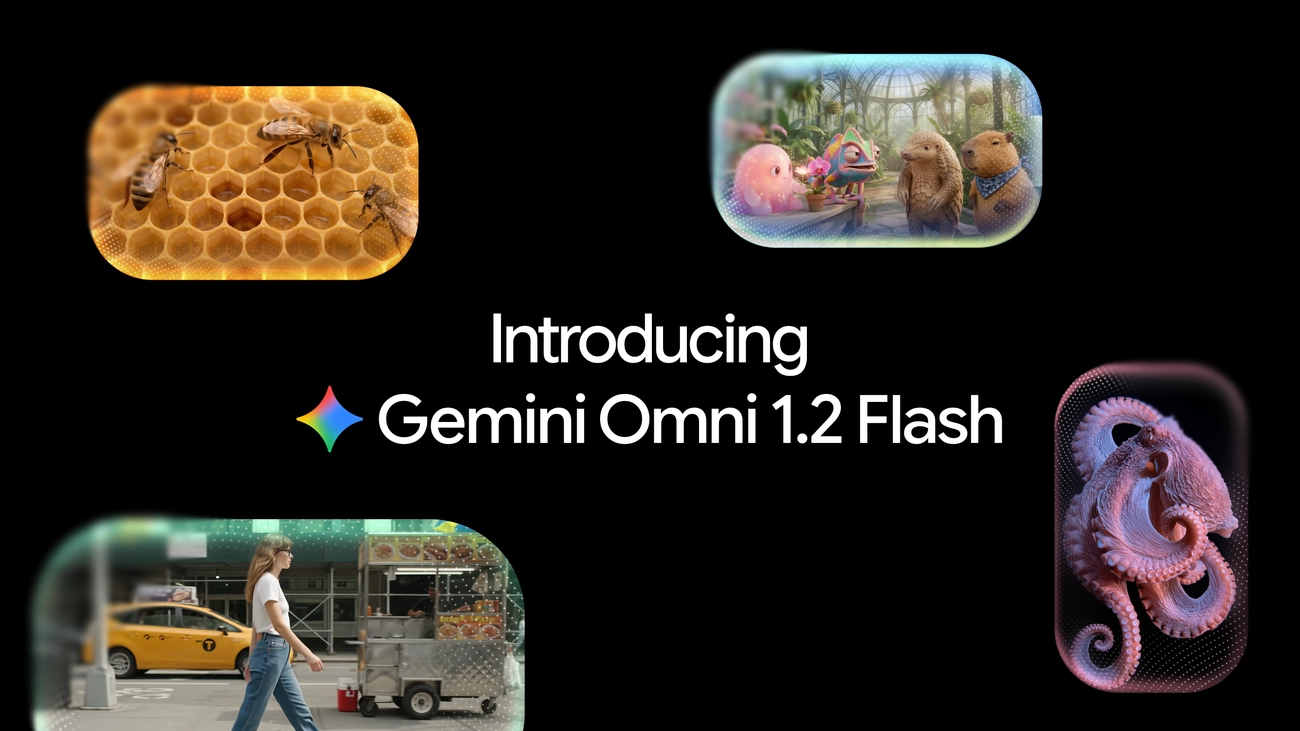
Google’s new video model costs about $0.07 per second of 720p output, and it will take over all requests sent to its predecessor on December 3, 2026. Gemini Omni 1.2 Flash also stretches a single clip to 15 seconds, up from 10 seconds in Omni 1.1.
Google DeepMind product manager Anish Nangia announced the model in a Google blog post on Gemini Omni 1.2 Flash on November 5. The company says the model is 30% cheaper than version 1.1. It is now generally available in the Gemini API and on Google Cloud.
What is new in Gemini Omni 1.2 Flash
The headline change is clip length. Users can set a duration anywhere from 3 to 15 seconds, in one-second steps. Google pitches this as enough for a full short story, a product explainer or a social ad in one pass.
Editing also works across the full 15 seconds. A user can refine the same clip turn by turn instead of starting over. Google lists swapping a product or background, changing the lighting or weather, and switching the aspect ratio as examples.
The model accepts several kinds of reference input:
- Character, product or style images
- Motion clips of up to three seconds
- Audio cues
According to Google, the model keeps faces, clothing, packaging text and brand colors consistent across camera angles. The company also claims less visual drift and morphing during motion and camera transitions. That applies when it fills in frames between a first and last keyframe, and when it extends a clip into a longer sequence.
Speech gets an upgrade too. Google promises more natural dialogue, clearer lip-sync and conditioning for multiple speakers. On the camera side, the model can follow complex moves such as FPV fly-throughs, dramatic pull-backs and orbit shots, with fewer unwanted jump cuts.
The Next Web reports that testers preferred version 1.2 over 1.1 for visual consistency 62% of the time in Google DeepMind’s comparisons.
What it costs at each resolution
Google’s blog post gives only the 720p price. The Gemini API pricing page fills in the rest. Google bills video by output tokens, at 5,792 tokens for each second of 720p video.
| Item | Omni 1.1 Flash | Omni 1.2 Flash |
|---|---|---|
| Video output, per 1M tokens | $17.50 | $12.00 |
| 720p, per second | About $0.10 | About $0.07 |
| 360p, per second | Not listed | About $0.023 |
| 1080p with upsampling, per second | Not listed | About $0.104 |
| 4K with upsampling, per second | Not listed | About $0.209 |
| Input (text, image, video), per 1M tokens | $1.50 | $1.50 |
| Maximum clip length | 10 seconds | 15 seconds |
| API free tier | Not available | Not available |
Google’s own math puts a 10-second 720p clip at about $0.70 and a 15-second clip at about $1.04. By our calculation from the listed rates, a 15-second clip costs roughly $0.35 at 360p and $3.14 at 4K.
That spread explains the workflow Google recommends. Draft at 360p or 720p, fix details with follow-up edits, then upscale the final version to 1080p or 4K. In practice, cheap drafts and edits replace full regenerations, which is where the savings come from. The pricing page does not list a separate price for edits or for the upscaling step itself.
What changes for you
Developers on Omni 1.1
The pricing page says that from December 3, 2026, all API requests to gemini-omni-1.1-flash will route to gemini-omni-1.2-flash automatically. Those requests will be billed at the 1.2 rates. Apps that still call 1.1 will get the new model’s output without a code change. Teams that tuned prompts or quality checks for 1.1 have less than a month to retest them on 1.2.
Developers can prototype in Google AI Studio, where the Gemini Omni API documentation is also hosted. The page notes that paid-tier data is not used to improve Google’s products.
Businesses
Companies can use the model in the Google Cloud console with Provisioned Throughput, a way to reserve capacity. The Next Web notes this is the first time Omni is generally available to businesses through Google Cloud. Google says the model runs on its enterprise infrastructure and security. Google Ads support aims at producing video ads at scale.
Consumers and creators
- Google Vids: 15-second clips at no extra cost with a Google account or Workspace subscription, according to Google. Vids can also add avatars, music and voiceover.
- Flow: scene directing, multi-character dialogue and multi-turn editing.
- Gemini app: rolling out to Google AI Ultra subscribers.
Every output carries an invisible SynthID watermark. Google’s Gemini Omni model page adds that content made in the Gemini app or Flow also carries C2PA Content Credentials.
How Omni got here
- May 2026: Google first showed Omni Flash at Google I/O, with a 10-second cap, The Next Web reports.
- Omni 1.1 Flash: priced at about $0.10 per second for 720p, with a 10-second limit.
- November 5, 2026: Omni 1.2 Flash launches at about $0.07 per second and 15 seconds.
- December 3, 2026: API calls to 1.1 switch to 1.2.
Limits and open questions
Google admits the model still struggles in some areas. It says work continues on fast sports action, rapid script changes and complex physics.
Length remains a gap against rivals. The Next Web points out that ByteDance’s Seedance 2.5, unveiled in June 2026, produces 30-second clips. That is twice the Omni limit.
Some details are still missing. Google has not given a price for each edit turn in the API. It has not said when the Gemini app rollout will reach all Ultra subscribers. The quality claims, including the 62% preference figure, come from Google’s own testing.