
Anthropic Launches Claude Smart Reports for Enterprise Users
Anthropic has officially launched a new reporting tool for its Claude AI. This powerful tool provides enterprise administrators with clear visibility. They can easily see exactly how their employees utilize this artificial intelligence platform. The newly unveiled Smart Reports feature is now available exclusively to premium Claude Enterprise subscribers. Managers can seamlessly activate this feature within their organization’s settings dashboard.
Comprehensive AI Usage Tracking
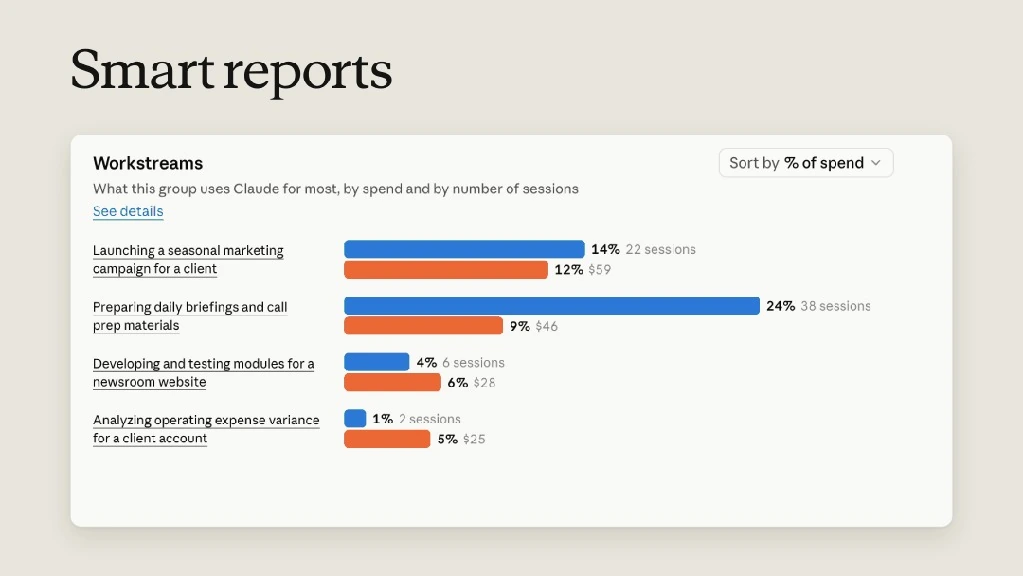
Released this Wednesday, the Claude Smart Reports functionality generates detailed visual charts. These helpful visualizations illuminate team engagement, specific content deliverables, and corresponding financial costs. Therefore, managerial personnel merely need to designate a target team. They then establish a timeframe spanning up to 28 days. Finally, they select the specific Claude applications they wish to scrutinize.
Administrators can include several modules in their analysis. These options include standard conversations, Claude Code, and Claude Cowork. They can also track the integrated Chat and Cowork unified interface. However, the recently debuted Claude Duet AI agent remains unsupported for Enterprise users currently.
The Smart Reports system meticulously extracts relevant data to aggregate employee utilization metrics. Furthermore, it intelligently parses team conversation logs. It categorizes the generated material into distinct workflows and output typologies. For instance, it identifies specialized programming code or comprehensive technical documentation. Simultaneously, the system calculates the associated financial footprint. For detailed guidance on these administrative capabilities, managers can consult Anthropic’s official documentation on Smart Reports, surveys, and pooled budgets.
Managing Budgets and Custom Queries
According to representatives from Anthropic, managers have direct control over user limits. “If team members find themselves hindered by stringent quota limitations, administrators possessing billing privileges can instantaneously elevate these thresholds directly from the reporting interface.”
This deployment arrives shortly after Anthropic submitted its initial public offering filings this past Monday. The financial disclosures revealed a staggering 900 percent year-over-year surge in existing customer expenditure. Nevertheless, the documents also highlighted substantial financial losses. The enterprise sustained an $80 billion deficit during the first half of 2026 alone. To accommodate varying corporate needs, enterprises are permitted to generate up to 10 complimentary reports monthly. After that limit, subsequent inquiries will incur supplementary charges.
Beyond establishing basic analytical focal points, managers possess the capability to forge customized queries. These queries can track specific consumption metrics and financial outlays. Consequently, administrators can permanently archive these bespoke inquiries for effortless future retrieval. This feature eliminates frustrating redundant data entry. Moreover, the framework proactively dispenses strategic recommendations. For example, it might suggest the implementation of novel protocols within corporate code repositories.
Interactive Charts and Bottleneck Identification
Every generated report yields highly interactive graphical representations. By clicking on these visual elements, supervisors can drill down into the granular details of individual sessions. These sessions are encapsulated within a specific workflow. Subsequently, administrators can filter and sort these sessions based on financial cost, utilized product, date of access, and output nature.
Crucially, the diagnostic tool also highlights operational bottlenecks and their recurrence rates. It adeptly identifies what Anthropic characterizes as “inefficient usage scenarios.” These scenarios encompass chat sessions that yield no actionable output. They also include interactions explicitly flagged for personal utilization, or dialogues that substantially deviate from professional objectives.
Navigating Ethical Concerns in the Workplace
However, the introduction of this pervasive AI statistical tracking apparatus will likely precipitate considerable unease among modern workers. Numerous journalistic investigations have already documented a growing corporate trend. Many companies are weaponizing artificial intelligence to dictate workforce reductions. Indeed, a recent survey illuminated a startling reality. One-quarter of managerial professionals in the United States rely on AI systems “frequently or consistently” when executing consequential human resources decisions.
In July, a cohort of former Meta employees leveled serious allegations against the tech behemoth. They claimed the company deployed inadequately vetted AI mechanisms to quantify employee productivity. The plaintiffs alleged these metrics were subsequently utilized to orchestrate large-scale layoffs. Meta vehemently repudiated these accusations. The company insisted that personnel determinations remain strictly a human endeavor.
Anthropic appears acutely cognizant of the ethical minefield surrounding algorithmic surveillance. The company has explicitly clarified that Claude Smart Reports are strictly prohibited from facilitating such punitive actions.
Strict Limitations on Data Queries
As articulated by Anthropic’s policy documentation, the tool has specific boundaries. “Smart Reports are engineered exclusively to comprehend tool proliferation and to strategically forecast Claude-related investments. Its architecture was fundamentally not designed for, and absolutely must not be deployed to, evaluate individual employee performance or orchestrate personnel determinations.”
To enforce these vital ethical boundaries, the framework imposes rigid limitations on query formulation. The system categorically forbids users from extracting sensitive personal data. Specifically, you cannot query information concerning race, gender identity, religious affiliations, or political orientations. It also blocks queries about immigration status, medical history, labor union participation, harassment grievances, or any facet of an employee’s private life.
Despite these stringent algorithmic safeguards, this comprehensive statistical reporting paradigm faces a steep uphill battle. It may inevitably struggle to cultivate endearment among employees. Ultimately, it might fail to foster genuine trust in corporate leadership.