
Fewer newly checked PCs carry 32GB or 64GB of memory than a year ago. That is the picture in the latest CPU-Z Validator statistics from CPUID, the company behind the popular CPU-Z hardware utility. Systems with 16GB and 8GB gained share over the same period. The shift comes as RAM prices keep climbing on demand from AI servers.
The figures appear on the CPU-Z Validator statistics page. CPUID labels its hardware rankings “Last 3 Months (Y2Y).” Each share is compared with the same three-month window a year earlier.
What the CPU-Z memory numbers show
32GB is still the most common amount of RAM, at 37.2% of validated systems. Its share fell 2.5% year over year. 16GB sits close behind at 33.0% after a 12.9% gain. 8GB rose 5.5% to an 11.0% share.
The bigger tiers lost the most ground. 64GB dropped 18.0% to a 7.3% share. 48GB fell 22.5%, 96GB fell 26.5% and 128GB fell 28.7%. The unusual 24GB size was the only tier above 16GB that grew, up 19.7% to 2.3%.
| RAM capacity | Share of CPU-Z validations | Change vs. a year earlier |
|---|---|---|
| 32GB | 37.2% | -2.5% |
| 16GB | 33.0% | +12.9% |
| 8GB | 11.0% | +5.5% |
| 64GB | 7.3% | -18.0% |
| 24GB | 2.3% | +19.7% |
| 4GB | 2.3% | -26.2% |
| 48GB | 1.7% | -22.5% |
| 12GB | 1.6% | -6.6% |
| 128GB | 0.6% | -28.7% |
| 96GB | 0.5% | -26.5% |
How to read these percentages
CPUID does not say whether its changes are relative or in percentage points. The numbers only make sense as relative changes. DDR2 memory, for example, holds a 0.6% share, so it cannot have lost 21.4 points. Read the relative way, the 64GB share slipped from roughly 8.9% to 7.3%. It did not fall by 18 points.
DDR4 and AMD’s AM4 platform are holding on
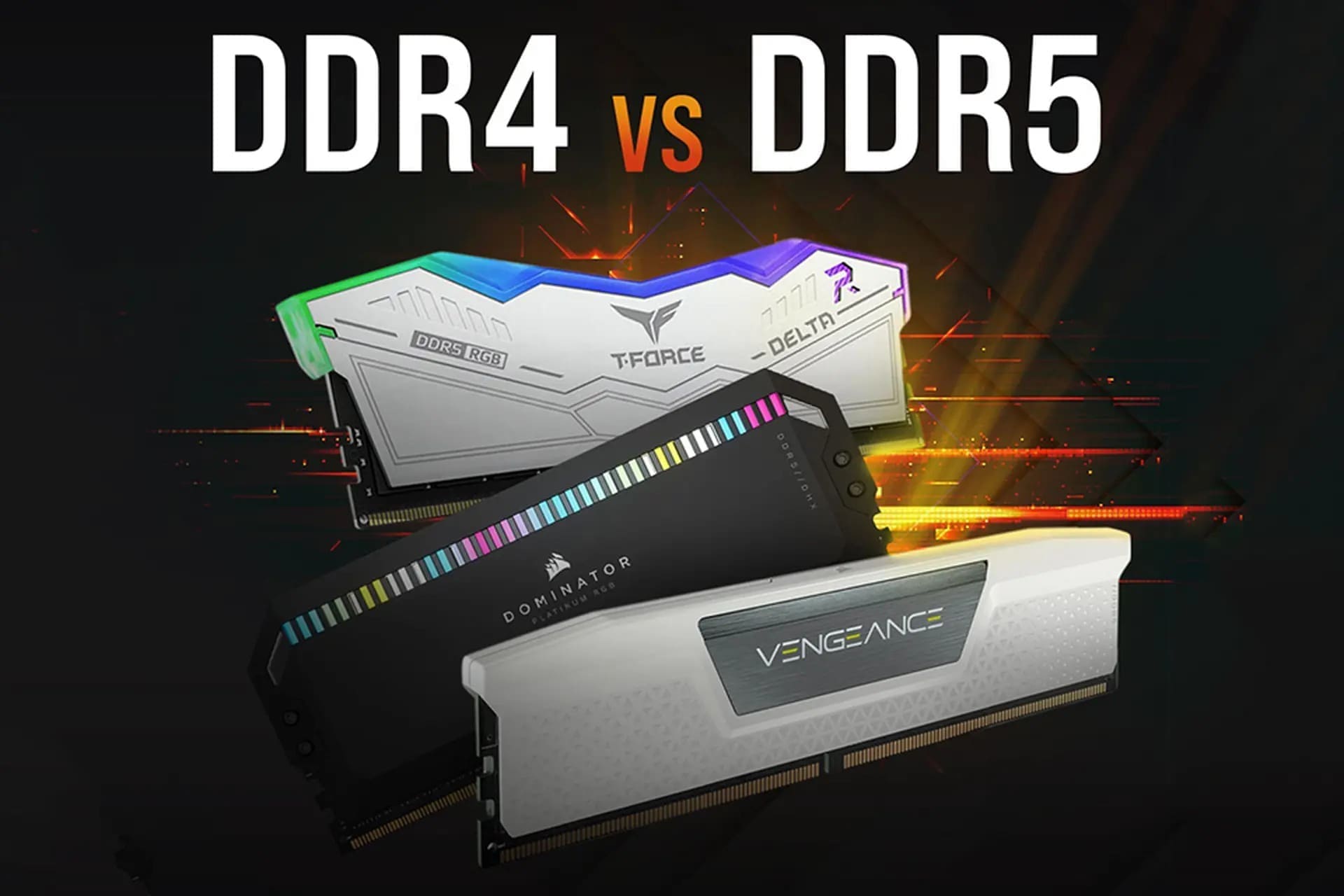
The memory generation split points the same way. DDR4 now appears in 54.5% of validated systems, up 6.0% from a year ago. DDR5 accounts for 32.9%, down 2.9%. DDR3 still shows up in 11.3% of systems after a 13.3% drop.
Older AMD chips are climbing the processor chart too. The Ryzen 7 5700X ranks second with a 3.2% share, up 42.8%. The Ryzen 5 5600 rose 36.1% to 2.2%. The Ryzen 5 5500 posted the biggest jump in the top 10, up 67.3% to 2.0%. All three run on the AM4 socket, which uses DDR4 memory.
Newer chips still lead the list. The Ryzen 7 9800X3D holds first place at 3.8%, though its share dipped 1.1%. Socket data backs up the trend. AM4 boards make up 23.5% of validations, up 17.5%, while AM5 sits at 17.1%, down 1.2%. Among chipsets, the AM4-era B550 leads at 13.9% after a 35.2% gain. The A520 rose 55.5% to 4.5%. The AM5 B650 fell 23.3% to 7.5%.
Why RAM prices are pushing buyers down a tier
Market tracker TrendForce expects memory to keep getting more expensive. In a September 30 forecast on fourth-quarter memory contract prices, it projected conventional DRAM contract prices to rise 10% to 15% quarter over quarter in 4Q26. It expects the pace of increases to slow. NAND flash contract prices are forecast to rise 15% to 20%.
TrendForce links the rise to AI. Suppliers are giving advanced production capacity to high-performance server products. Demand from AI servers and agentic AI is driving server DRAM and enterprise SSD orders. On the consumer side, weak demand and rising costs are hurting PC, smartphone and device sales.
The firm also says notebook inventories now reflect higher component costs, which weighs on sales. PC makers are cutting SSD capacities to lower costs. Looking ahead, TrendForce expects DRAM supply to stay tight in 2027. It warns that PC DRAM supply could decline as more capacity shifts to servers.
Contract prices are what PC makers and other large buyers pay memory suppliers. They are not retail prices, but they feed into the cost of new PCs and upgrade kits.
Steam’s survey shows a similar shift
Valve’s October 2026 Steam Hardware Survey for Windows PCs points in a similar direction, with one exception. 16GB is now the most common amount at 41.27%, up 3.67 points in a month. 32GB fell 5.10 points to 38.18%. Based on those changes, 32GB led a month earlier. Unlike CPU-Z, Steam shows 64GB edging up 0.26 points to 3.95%.
| Measure | CPU-Z Validator | Steam survey (Windows) |
|---|---|---|
| Comparison period | Last 3 months vs. a year earlier | October vs. September 2026 |
| Most common RAM size | 32GB (37.2%) | 16GB (41.27%) |
| 16GB trend | Up 12.9% (relative) | Up 3.67 points |
| 32GB trend | Down 2.5% (relative) | Down 5.10 points |
| 64GB trend | Down 18.0% (relative) | Up 0.26 points |
The two samples differ. Steam polls its own users, while CPU-Z counts systems that people choose to submit. Their time frames also differ, so the numbers should not be merged.
What changes for you
The data suggests many builders are holding back on memory spending. In practice, that means 16GB is becoming the default again for budget and mid-range systems. Staying on a DDR4 platform also lets owners reuse memory they already have.
If you are planning a build or upgrade, a few checks can help:
- Check what you already have. In Windows, open Task Manager, select Performance and then Memory to see your capacity and speed. The Memory tab in CPU-Z shows whether your modules are DDR4 or DDR5.
- Count your free slots. Adding a matching module may cost less than replacing a full kit.
- Factor memory into the platform choice. A move to AM5 or a newer Intel platform usually means buying DDR5 at today’s prices.
- Watch prebuilt specs. TrendForce says PC makers are trimming SSD capacities to cut costs, so compare storage and RAM sizes closely.
What the data cannot tell us
The CPU-Z figures have clear limits. They cover only systems whose owners submitted them through the Validator. They are not sales data, and they do not count every PC in use. They also do not show people pulling memory out of existing machines.
The statistics cannot prove that RAM prices caused the shift either. The timing matches, but CPUID offers no explanation. Its page also does not state when the figures were last updated.
What remains unclear is how long the trend will last. TrendForce expects tight DRAM supply through 2027. The next CPU-Z snapshot and Steam’s November survey will show whether 16GB and DDR4 keep gaining.