
Google’s new Gemini 4 Neon costs $3 per million input tokens and $15 per million output tokens. That is double the list price of Gemini 4 Hydrogen, but below the $4 and $20 that Gemini 4 Carbon will cost from December 1.
Google announced Neon on November 18 in a blog post by Koray Kavukcuoglu, Chief AI Architect and SVP at Google DeepMind. The company pitches it as a middle option for complex coding, analysis, science and business workflows. It is now available to developers, businesses and paying Google AI Pro and Ultra subscribers.
What Gemini 4 Neon is
Neon sits between the two models Google released earlier this month. Google describes Carbon as the model for the hardest long-horizon projects. Hydrogen is the fast model for everyday work. Neon aims to balance depth and efficiency.
According to the Gemini 4 Neon model card, the model is adapted from Gemini 4 Carbon. It accepts text, images, audio and video, and it replies in text.
The context window holds 1 million tokens, shared between input and output. A normal response can run up to 64,000 tokens by default. A background “long decode” mode can stretch output up to 1 million tokens. The knowledge cutoff is March 2026, and Google warns that some domains may be less current.
Neon also offers four thinking levels. These settings trade answer depth against token spend. High is the default, and xhigh adds deeper multi-step reasoning.
What changes for you
The impact depends on how you use Google’s AI tools.
Google AI Pro and Ultra subscribers
Pro and Ultra subscribers can pick Neon from the model menu in the Gemini app. Tasks in Gemini can also run on it. Google says Neon reads spreadsheets, PDFs and photos more precisely and can pull details from Gmail and Docs. It also lists jobs such as checking billing statements or cross-checking receipts for refunds.
This matters most for Pro users. When Google launched Carbon on November 10, its Carbon announcement listed Gemini app access for Ultra subscribers. Neon gives Pro subscribers a model that, according to Google, approaches Carbon’s quality. Pro and Ultra subscribers also get Neon in Google Antigravity and AI Studio.
Free users
Google does not list Neon for free users in the Gemini app. Developers need the paid tier of the Gemini API, according to Google’s post.
Developers
Neon is rolling out in the Gemini API, Google AI Studio and Android Studio. Cached input costs $0.15 per million tokens, which Google calls a 95% discount.
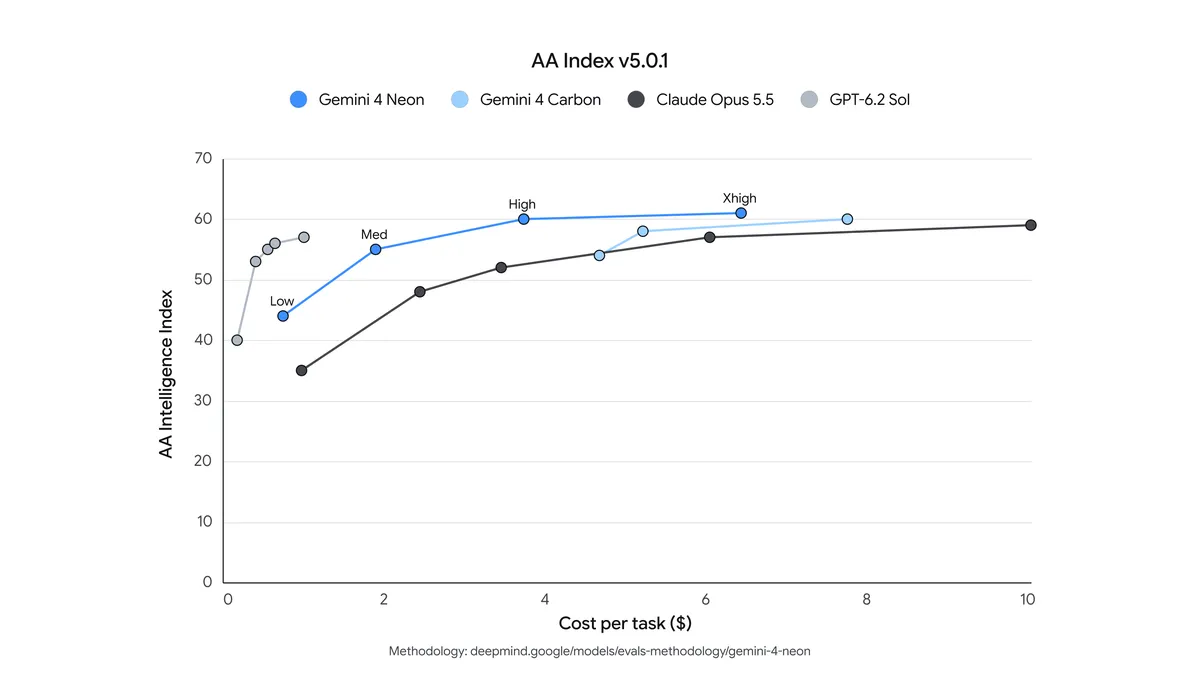
The price per token is not the full story. Google says that at the default high level, Neon costs 32% less per task than Carbon. Google also claims xhigh costs at least 36% less per task than rival models at their top settings. These are Google’s own figures under specific test conditions.
Timing also matters. Until November 30, Carbon runs at an introductory $2 and $10, which is cheaper per token than Neon. From December 1, Carbon moves to $4 and $20.
GitHub Copilot users
GitHub’s changelog says Neon is generally available in Copilot Pro+, Max, Business and Enterprise. Copilot Free and Pro are not on that list. The rollout is gradual, so some users may not see it yet.
GitHub says the model appears in VS Code, Visual Studio, JetBrains IDEs, Xcode, Eclipse, Copilot CLI, the coding agent, github.com and GitHub Mobile. Billing is usage-based at the provider’s list price.
Business and Enterprise admins should check their model policy. Under default enablement, new models turn on automatically unless an admin has disabled the global default or this model.
Security teams
A separate “Neon for cyber” version is rolling out to vetted defenders in Google’s Fairwind Program over the coming days. Requests go through a Google Cloud account team.
How the Gemini 4 models compare
The table uses only figures from Google’s announcements. Hydrogen’s cached price was not listed in its launch post.
| Model | Input / output per 1M tokens | Google’s positioning | Gemini app access |
|---|---|---|---|
| Gemini 4 Hydrogen | $1.50 / $7.50 | Fast everyday tasks | Model menu; free users via auto selection |
| Gemini 4 Neon | $3 / $15 ($0.15 cached input) | Balance of depth and efficiency | Google AI Pro and Ultra |
| Gemini 4 Carbon | $2 / $10 until Nov 30, then $4 / $20 | Hardest long-horizon projects | Listed for Google AI Ultra |
A fast run of Gemini 4 launches
- October 13: Gemini 4 Argon became generally available in the Gemini API.
- November 10: Google announced that Gemini 4 Carbon, its strongest model, was available.
- November 12: Google introduced Gemini 4 Hydrogen as its fast, low-cost model.
- November 18: Gemini 4 Neon arrived, along with its GitHub Copilot release.
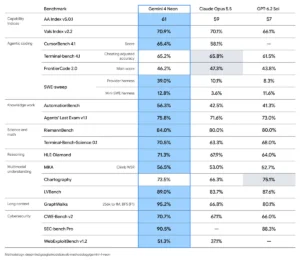
Benchmarks Google is citing
All scores below come from Google’s announcement. Independent tests may differ.
- Artificial Analysis Intelligence Index: 61 at xhigh, third overall, behind larger and slower models.
- Artificial Analysis Coding Agent Index: first overall at 58.6.
- Vals Index: second at 70.9%, and first on Vals Legal Research Bench and Tax Agent Bench.
- Coding: 65.2% on Terminal-Bench 4.1 and 46.2% on FrontierCode 2.0 at high.
- Agents: 56.3% on Zapier AutomationBench and $16,843 on Andon Labs Vending-Bench 2, both first place. Arena’s Agent Arena Index placed it second with 1336.
- Science: 70.5% on Terminal-Bench Science, 84.0% on RiemannBench and 71.3% on HLE-Diamond.
Google also says Neon recorded its lowest fabrication rate so far in internal Antigravity testing. GitHub, citing Google, says Neon approaches Carbon’s quality at a lower token cost per task. It adds that the model makes fewer unrequested code changes and fewer unsupported claims about code, tools or test results.
Technical details: agents and safety
In Antigravity, Neon can work alone or act as an “Orchestrator.” In that role it directs several Hydrogen subagents working in parallel. Google says it cuts redundant file reads, shares progress as it works and handles context compaction in long sessions. Context compaction means shrinking older conversation history so a long job fits in memory.
Google reports a 0.09% misaligned action rate and a 99.2% pass rate on its agent honesty test. On Terminal-Bench 4.0, Neon refused 1.98% of tasks and showed 0.0% cheating. Compared with Carbon, Google says under-service fell 43% to 56% and overreach fell 15% to 35%, depending on the effort level.
The model card adds a detail missing from the launch post. Google carried forward its Frontier Safety Framework results from Gemini 4 Argon. It found that Neon’s capability gain over Argon stayed below the level that would trigger a full new evaluation.
Under those results, Google says it cannot rule out a critical capability level for biological uplift or for cybersecurity uplift. Google says it is deploying mitigations in both areas. It also lists hallucination and jailbreak resistance as known limitations.
What remains unclear
Google has not yet published the full Safety and Security Report for Neon. The model card marks it as “coming soon.” The launch post also does not mention Vertex AI availability.
The benchmark claims also need outside checks. Google’s speed and cost claims rely on its own test setups. Developers should compare cost per task on their own workloads before switching from Carbon or Hydrogen.