

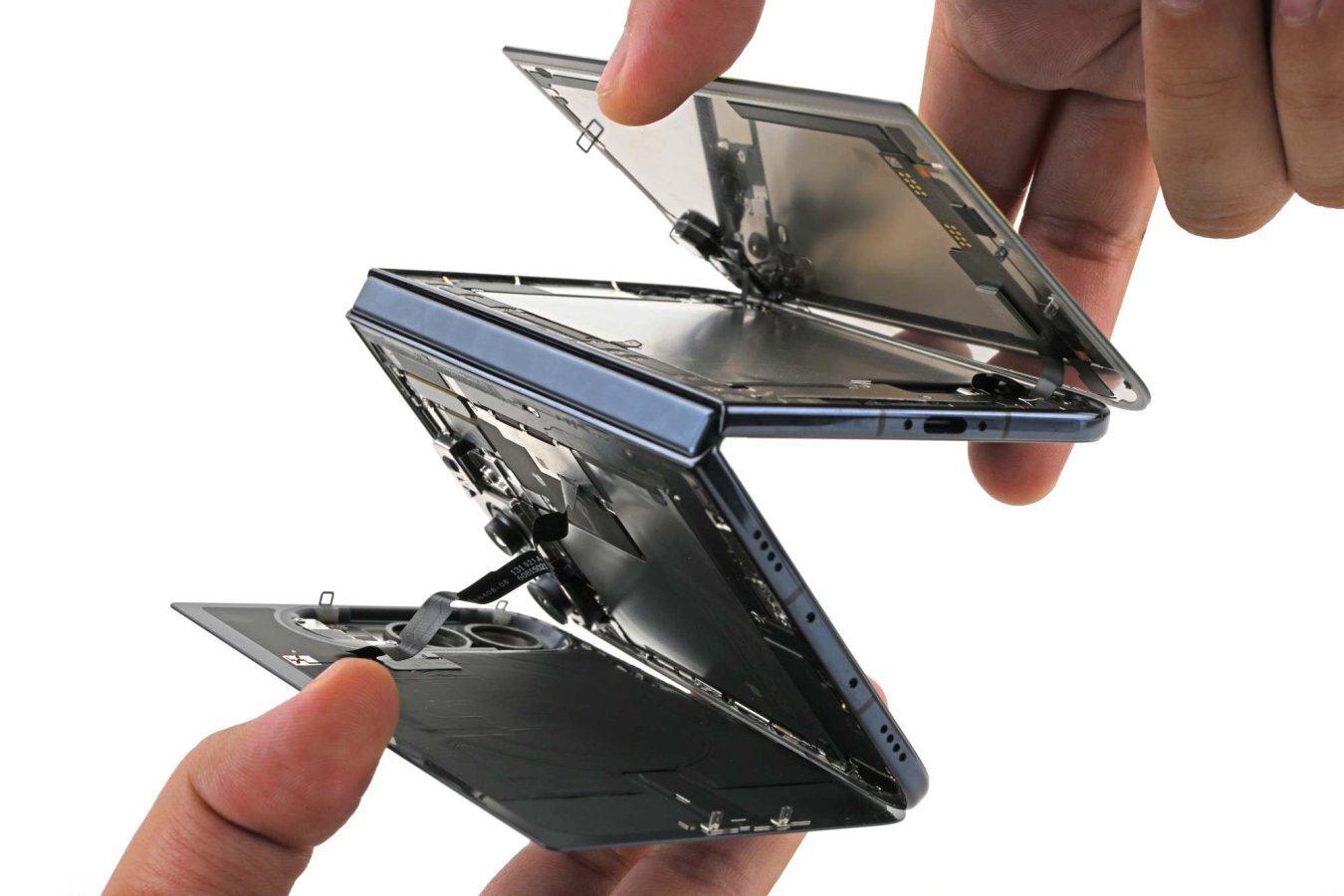
iFixit Dismantles the iPhone Duo
The repair experts at iFixit have recently completed a comprehensive teardown of the highly anticipated Apple iPhone Duo. This exhaustive examination exposed numerous brilliant engineering highlights alongside several potential vulnerabilities. Consequently, the organization has officially proclaimed this device as the most easily repairable foldable smartphone currently available.
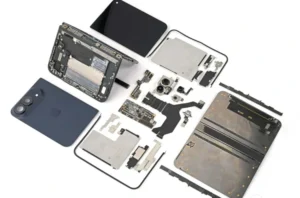
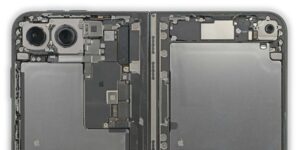
Among the numerous discoveries during this teardown, the repairability score emerged as the most pleasant surprise. Remarkably, this innovative device achieved an unprecedented 5 out of 10 points. This represents the highest score iFixit has ever awarded a foldable smartphone in its history.
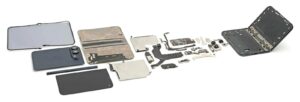
Admittedly, this represents a provisional evaluation. The definitive score awaits confirmation until official replacement components formally arrive on the consumer market. Nevertheless, for Apple’s inaugural venture into foldable devices, this preliminary outcome remains extraordinarily encouraging.
The Complex iPhone Duo Hinge Architecture
Unsurprisingly, the primary focus of this teardown centered squarely upon the hinge mechanism. Undeniably, this component stands as the iPhone’s crowning technological achievement. iFixit noted that patents filed by Apple several years ago had previously hinted at this fundamental design philosophy. However, upon physically dismantling the authentic device, observers discovered a system far more intricate than those initial schematics suggested.
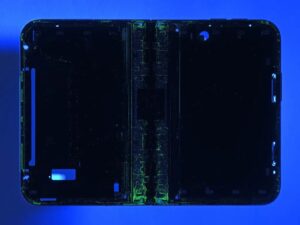
The disassembly predictably commenced with iFixit’s classic fluorescent powder test. This methodology allows technicians to meticulously track the ingress pathways of particulate matter throughout the dismantling process. The iPhone Duo boasts an impressive IP68 ingress protection rating. It is entirely impervious to dust and can withstand immersion in six meters of water for thirty minutes.
Immediately following this rigorous test, technicians noticed a faint, gritty friction sound during hinge actuation. However, further disassembly revealed relatively minimal powder intrusion within the internal hinge assembly. Compared to alternative foldable devices subjected to identical testing, the iPhone Duo’s dust resistance proved significantly superior.
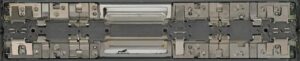
The interior of the hinge integrates a multitude of microscopic gears, robust springs, and articulated metallic joints. Furthermore, it employs a sophisticated water-drop structural configuration. This design deliberately allocates space for the screen during flexure, thereby preventing excessively acute bending angles. Currently, the vast majority of foldable smartphones utilize similar water-drop hinge designs. Yet, Apple has infused this architecture with numerous proprietary engineering innovations.
Additionally, Apple installed specialized curved guiding structures. These mechanisms precisely control the trajectory of the joint movements, effectively mitigating the tensile stress exerted upon the delicate display during opening and closing maneuvers.
Potential Catalysts for Premature Screen Failure
Discussing structural stress, iFixit has identified several plausible catalysts for the premature screen failures reported by early iPhone Duo adopters. Numerous users have complained of an audible “clunk” during articulation, immediately followed by the sudden appearance of horizontal bright lines across the internal display.

Significantly, the overwhelming majority of these hardware failures concentrate in a singular, specific location. The damage occurs precisely where the connection aperture between the two chassis halves intersects with the central hinge support structure.
To isolate the root cause of this damage, technicians constructed a sophisticated three-dimensional digital model of the hinge. They utilized CT scans, macro teardown photography, and Apple’s own patent documentation.
They proposed two primary hypotheses. Firstly, when the device closes, the central support mechanism might fail to retract correctly, thereby continuously compressing the display inwards. Secondly, the curved guide rails dictating hinge movement might elevate above surrounding components during the folding sequence. If these rails become obstructed and fail to return to their designated resting position, they could severely abrade the fragile screen.
iFixit further emphasized that this specific failure zone represents an unfortunate confluence of numerous structural edges and mechanical components. Consequently, physical stress concentrates disproportionately upon the highly vulnerable, multi-layered display panel.
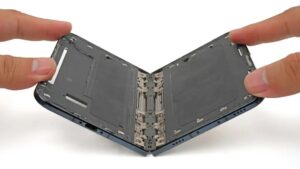
While this specific teardown could not definitively confirm the exact root cause of these malfunctions, the location of the reported damage aligns perfectly with the internal hinge architecture. This correlation provides a lucid trajectory for subsequent, in-depth investigations.
Fascinating Additional Discoveries
iFixit also scrutinized the iPhone Duo’s matte nano-texture internal display. According to official Apple documentation, this specialized surface treatment scatters ambient light, thereby diminishing the visual prominence of the central crease. Under intense microscopic examination, the screen surface reveals a dense array of microscopic circular protrusions. These structures effectively diffuse reflected light, rendering the crease remarkably inconspicuous.
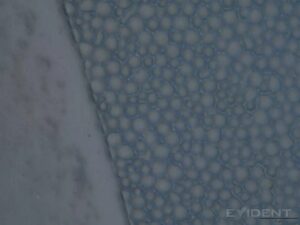
Microscopic analysis of the pixel arrangement also yielded novel discoveries. Certain sub-pixels exhibit an elliptical geometry with diverse orientations, eschewing a uniformly aligned pattern.
Citing a specific Apple patent, iFixit postulated that this unconventional arrangement effectively mitigates visual distortion caused by optical diffraction, thereby further concealing the central fold. The teardown publication includes high-resolution macroscopic imagery of this pixel matrix, visually demonstrating Apple’s ingenious approach to optimizing anti-reflective performance.
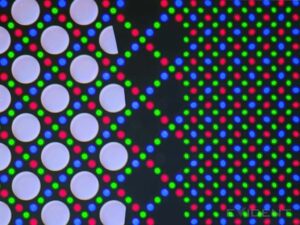
Examining the pixel layout further, the area situated immediately above the internal front-facing camera received highly specialized treatment. Mirroring the under-display infrared camera implementation utilized in the iPhone 18 Pro, the Duo expands the interstitial spacing between pixels in this specific zone. This deliberate design ensures sufficient ambient light can penetrate the display and reach the concealed camera sensor below. Within this precise area, the individual pixels feature a distinctly rounder shape and a significantly more regimented arrangement.
The display assembly incorporates another immensely beneficial design choice. The bezels surrounding the internal screen are secured primarily by mechanical clips, rather than relying exclusively upon tenacious adhesives. Consequently, they are far less susceptible to accidental damage during extraction. The external display is similarly effortless to remove. This represents phenomenal news for repairability, as numerous internal service procedures mandate the prior removal of this exterior screen.
An Elegant Battery Configuration
Shifting focus to the power delivery system, iFixit revealed a dual-cell battery configuration. One battery resides beneath the rear glass panel, while the secondary unit is positioned beneath the external display. Therefore, replacing both power cells necessitates dismantling both the left and right halves of the chassis. The larger battery features a rated capacity of 11.567 watt-hours, while the smaller counterpart provides 7.506 watt-hours, culminating in a total combined capacity of 19.073 watt-hours.
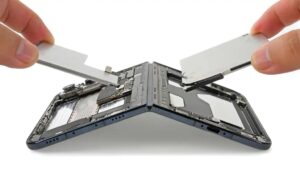
Crucially, both batteries utilize electrically releasable adhesive strips. Applying a minor electrical current instantly relinquishes the adhesive bond, completely eliminating the need for forceful prying. iFixit lauded this implementation, declaring it the most elegant and seamless battery extraction design ever witnessed in a foldable smartphone.
Ultimately, this comprehensive teardown also dissected the iPhone Duo’s revolutionary motherboard architecture, the complex multi-layered structure of the display, and the precise mechanical principles dictating how each individual panel layer moves independently to accommodate the folding action.