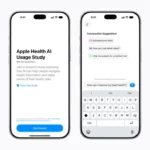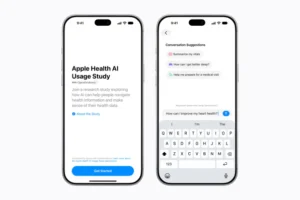

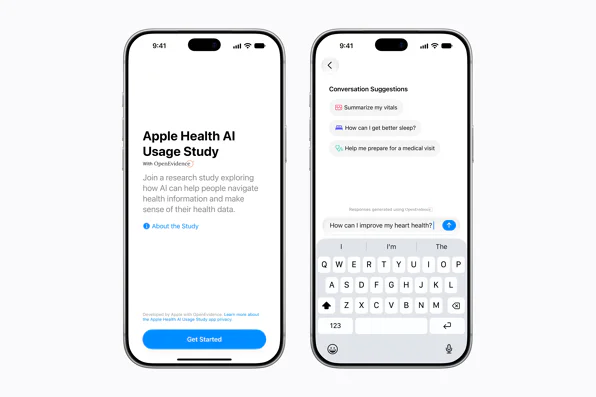
Apple now lets up to 200,000 people in the United States ask a health chatbot questions on their iPhone. There is a catch: the only way in is to join a research study. The Apple Health AI Study App is the companion app for that study, which Apple runs with clinical AI company OpenEvidence.
The app is not a general release, and the entry rules are strict. Before you sign up, it helps to know what the chatbot can do, what happens to your questions, and what leaving the study does and does not change.
What Apple launched
Apple calls the project the Apple Health AI Usage Study. According to Apple’s announcement of the Health AI Usage Study, published on November 15, 2026, it examines four things. These are what drives user trust, the quality of AI answers, how well people understand health information, and which everyday health actions they take afterward.
Apple says the findings should inform the responsible design of health AI for Apple and for the wider industry. OpenEvidence supplies the AI. Its clinical platform is widely used by healthcare professionals, and Apple says the answers draw on sources such as The New England Journal of Medicine, the Journal of the American Medical Association and Nature.
Apple and OpenEvidence presented the study on stage at the HLTH conference in Las Vegas, Healthcare Dive reported. Sumbul Desai, Apple’s vice president of Health and Fitness, said there that the study was designed by Apple but uses AI developed by OpenEvidence.
What you can do in the app
Participants can ask everyday health questions and get complex medical information explained in simpler language. Apple says each answer comes with linked, peer-reviewed clinical citations. The Apple Health AI Study App listing on the App Store names four main uses:
- Understanding symptoms or conditions
- Putting personal health data in context
- Preparing for a medical visit
- Building a personalized exercise or meal plan
Sharing personal data is optional. Participants can pick HealthKit data types such as resting heart rate, activity, sleep or lab results. Apple says this shows how personal data affects the relevance and clarity of answers.
The app also has safety guardrails. Apple says it detects certain concerning questions and suggests that the participant contact a provider or other resources. Apple adds that the app is not meant to diagnose or treat any condition, or to replace advice from medical professionals.
Who can join
The table below combines the requirements in Apple’s announcement with details from the App Store listing.
| Item | Requirement or detail |
|---|---|
| Country | United States |
| Minimum age | 21 |
| iPhone | Apple Intelligence-enabled iPhone (iPhone 15 Pro or later) |
| Software | iOS 26 or later |
| Study size | Up to 200,000 participants |
| App language | English only |
| Price | Free |
| App size | 29.9 MB |
One detail differs between reports. TechCrunch’s report on the study app listed iPhone 15 or later, with Apple Intelligence enabled. Apple’s own announcement says iPhone 15 Pro or later. By Apple’s wording, the standard iPhone 15 and iPhone 15 Plus do not qualify.
The ages also differ. The App Store rates the app 18+, but the study sets its minimum age at 21.
What happens to your data
Apple says study data will not be used to train AI models. Participants control whether they share HealthKit metrics or survey responses. Apple also says it has security measures to protect the study data it keeps.
TechCrunch reported further details. Data is anonymized before it goes to a secure third-party cloud provider. OpenEvidence deletes query and response data after 24 hours.
The App Store privacy label adds a little more. Apple reports that the app collects a user ID that is linked to you, used for analytics and app functionality. It also collects performance diagnostics that are not linked to you.
The fine print on leaving the study
The App Store listing points to Apple’s privacy policy for its health study apps. That policy covers Apple’s health studies in general. It does not mention the Health AI Usage Study by name, and each study’s consent form adds its own terms. Still, it sets out rules worth reading before you enroll:
- Your contact information is replaced with a random code before data reaches Apple’s systems.
- Coded data can be used to run the study, develop health-related products and improvements, and publish findings that do not identify you.
- You can leave a study at any time. Apple may keep data it has already collected and continue to use it, but it stops collecting new data.
- The policy warns that “deleting an App will not withdraw you from the Study.”
In other words, removing the app from your iPhone is not the same as quitting. The withdrawal steps sit in the study’s consent form, so read that screen before you agree.
How to join
- Check that you have an iPhone 15 Pro or later running iOS 26 or later.
- Make sure Apple Intelligence is turned on.
- Download the Apple Health AI Study App from the US App Store.
- Read the study information and consent form, then choose to enroll.
- Decide which HealthKit data types, if any, you want to share.
Expect to do some work in return. TechCrunch reported that participants rate answers, give feedback and are asked to take monthly surveys. It put the study length at more than 12 months.
Why Apple is testing a health chatbot now
People already use chatbots for health questions. TechCrunch noted that OpenAI and Anthropic have launched chatbots with specialized health features. OpenAI said earlier in 2026 that users ask more than 300 million health-related questions each week, according to the same report.
Healthcare Dive cited KFF data showing that roughly one-third of US adults have used an AI chatbot to discuss their health. Apple itself admits that LLM-based health tools can give incomplete or unclear answers. That gap is a key reason for the study.
Desai framed the project around caution. “At Apple, we believe responsible innovation starts with scientific rigor and clinical grounding,” she said in Apple’s announcement. Robert M. Wachter, chair of the Department of Medicine at UCSF, said patient and clinician AI tools “are being built and tested in separate worlds.”
OpenEvidence CEO Daniel Nadler joined Desai on stage. Healthcare Dive reported that he pointed to doctor visits that often last only 10 to 15 minutes. He said the app could help users bring their health data and questions to that short window. STAT reported that Nadler compared the pairing of the two companies to “peanut butter and jelly.”
The study sits next to a separate Apple project. A redesigned Health app built with Apple Intelligence returned in the iOS 27.3 beta, and MacRumors reported on the redesigned Health app that iOS 27.3 is expected in December. Apple has not linked the study to that app.
What remains unclear
- Product plans: Apple has not said whether chatbot answers like these will reach the Health app or Siri. Healthcare Dive noted only that Apple could use the findings to inform its healthcare AI products.
- Study length: Apple’s announcement gives no end date. The 12-month figure comes from TechCrunch.
- Other countries: The study is limited to the US, and the app is listed in English only. Apple has not mentioned plans for other regions.
- Data after withdrawal: Apple’s general study policy allows it to keep collected data. It is not yet clear how that rule works alongside OpenEvidence’s 24-hour deletion of queries.
For now, the app is best seen as what Apple says it is: a research tool, not medical advice. Anyone with a health concern should still talk to a doctor.