
Strata Engine Democratizes Massive AI Model Execution
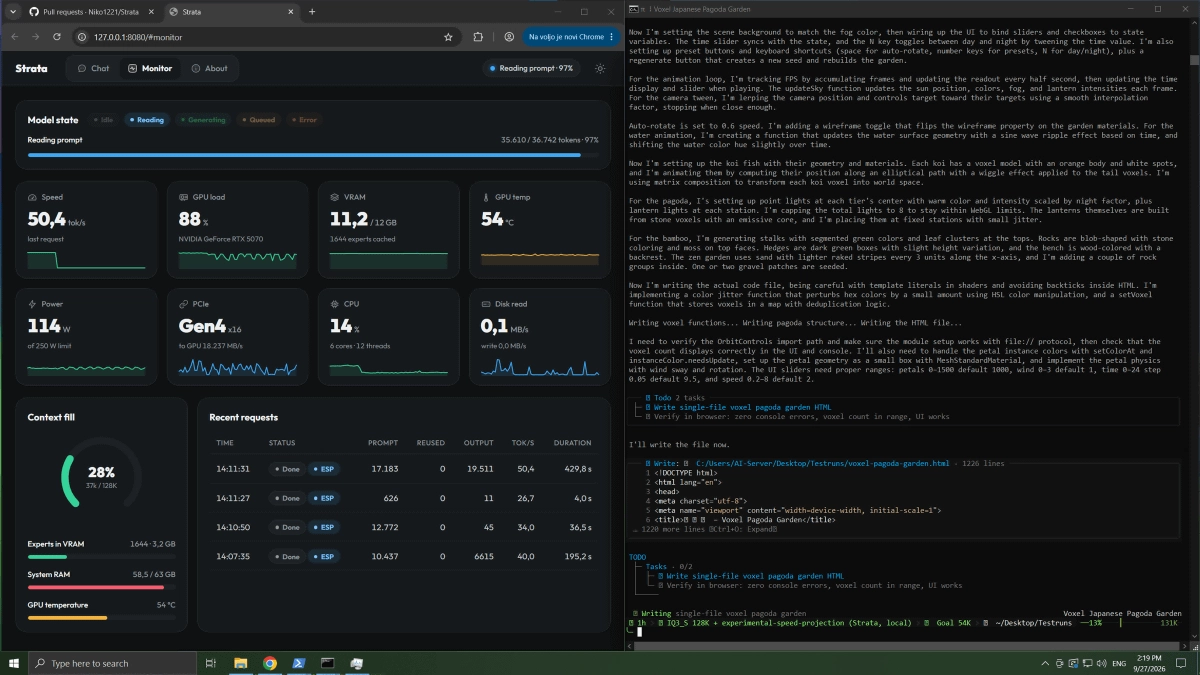
According to a recent feature published by Gigazine, developer Niko1221 has publicly released the Strata open-source AI engine. This innovative software empowers consumer-grade graphics cards equipped with a mere 12GB of VRAM to execute the massively quantized Qwen3.8-Flash-Next model, which encompasses an astonishing 125 billion parameters.
Understanding the Qwen Architecture
The Qwen3.8-Flash-Next iteration serves as a highly compressed variant of the multimodal Mixture-of-Experts architecture. Alibaba’s Qwen team originally unveiled this technology in August 2026. This sophisticated AI model integrates 125 billion active parameters alongside a massive 51-billion-parameter n-gram embedding table. Consequently, it natively supports an expansive context window of 262,000 tokens.
Innovative Memory Management Strategies
To successfully mitigate excessive video memory consumption, the Strata open-source AI engine strategically deploys two paramount technologies. Primarily, it allocates the overarching MoE model into standard system RAM, deliberately transferring only the most frequently accessed expert modules into the GPU VRAM. Secondly, the engine harnesses lightweight models for speculative decoding. This technique rapidly anticipates subsequent tokens, thereby dramatically accelerating the overall inference trajectory.
Hardware Prerequisites
Regarding indispensable hardware prerequisites, deploying Qwen3.8-Flash-Next mandates specific baseline configurations. Enthusiasts require an NVIDIA or AMD graphics card possessing at least 12GB of VRAM, coupled with a minimum of 32GB of system RAM. Furthermore, the setup demands upwards of 80GB of available storage space, ideally utilizing a solid-state drive. Finally, it necessitates a Windows 10, Windows 11, or Linux operating system environment.
Comprehensive Performance Metrics
When evaluating performance metrics, the engine demonstrates remarkable operational efficiency across different hardware environments.
NVIDIA Host Performance Metrics
Hardware Configuration: NVIDIA RTX 5070 (12GB VRAM), AMD Ryzen 5 7600, 64GB System RAM.
- Q2_0: 94 tokens/second (Write) | 2650 tokens/second (Read)
- IQ2_XS: 79 tokens/second (Write) | 2090 tokens/second (Read)
- IQ3_XXS: 62 tokens/second (Write) | 1750 tokens/second (Read)
- IQ3_S: 53 tokens/second (Write) | 1620 tokens/second (Read)
- Coder: 55 tokens/second (Write) | 2180 tokens/second (Read)
AMD Host Performance Metrics
Hardware Configuration: AMD Radeon RX 9070 XT (16GB VRAM), AMD Ryzen 9 3900X, 47GB System RAM.
- Q2_0: 60 tokens/second (Write) | 1160 tokens/second (Read)
- IQ2_XS: 52 tokens/second (Write) | 1110 tokens/second (Read)
- Coder: 44 tokens/second (Write) | 1420 tokens/second (Read)
Within these specific benchmarks, the “write” metric corresponds to the generative output velocity. Conversely, the “read” metric signifies the speed at which the system processes the initial prompt context.