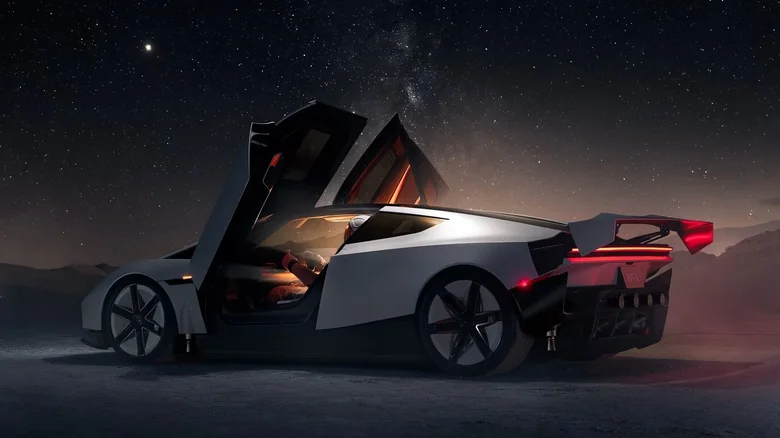
Tesla Second-Generation Roadster Re-Announced with Rocket Boosters
Tesla utterly dominated the automotive headlines this Thursday by executing a breathtaking stunt. While announcing the redesigned second-generation Roadster at an October 15 event, the electric vehicle titan literally added rocket fuel to the presentation. The spectacle involved the Tesla Roadster driving up a massive C-shaped ramp on a specialized suction rig until it hung completely upside-down. Subsequently, the sleek vehicle floated gracefully back to the ground utilizing actual rocket boosters. Furthermore, the company revealed that this highly anticipated sports car targets a 2028 production window. To secure the premium “Thrust” trim level, which features these cold-gas thrusters, interested buyers must place a staggering $250,000 reservation. “We enter production in 2028,” CEO Elon Musk declared during the showcase. “Actually, for real.”
A History of Delays and Broken Promises
If this announcement induces a profound sense of deja vu, you are perfectly justified in your skepticism. This grand spectacle certainly does not mark the first time Tesla has revealed the second-generation Roadster. Unsurprisingly, the company completely avoided acknowledging that undeniable fact during this latest re-announcement. Consequently, a pressing question lingers on many minds: Is this just another paper launch for Tesla’s perpetually delayed sports car?
The original Roadster represented a monumental milestone for Tesla during its embryonic stages. Released back in 2008 and manufactured in extremely limited quantities, the vehicle was initially conceptualized by Martin Eberhard, one of Tesla’s original founders. This occurred well before current CEO Elon Musk bought out Eberhard and his partner, Marc Tarpenning. The very idea of the Roadster originally attracted Musk to the fledgling startup in 2004, prompting his crucial initial investment. He subsequently oversaw the turbulent production of that foundational sports car. Ingeniously crammed inside the modified chassis of a Lotus Elise, witnessing a battery-powered vehicle achieve 244 miles on a single charge was truly revolutionary for that era.
The “SpaceX Package” and Missed Deadlines
Tesla first unveiled the redesigned Roadster with massive fanfare in November 2017. The automaker promised it would become the absolute apex of their innovations in electric vehicle manufacturing. Musk confidently described the machine as “a hardcore smackdown to gasoline cars.” Originally targeted for an ambitious 2020 release, Tesla showcased it alongside the Semi, a Class 8 electric semitruck that also suffered severe production stalls. In February 2018, Musk promised an optional “SpaceX” package. He claimed this upgrade would seamlessly arrange approximately ten small rocket thrusters around the car, dramatically improving acceleration, top speed, braking, and high-speed cornering.
Then, the agonizing delays commenced. Despite Tesla eagerly accepting massive deposits ranging from $50,000 up to $250,000, the initial 2020 production window quietly vanished. During a July 2020 earnings call, Musk stated that production would finally begin within the following 12 to 18 months. Since a devastating public health crisis had engulfed the globe, this particular delay seemed somewhat understandable. Ironically, Musk noted in an interview with Joe Rogan that same year that he urgently wanted to build the Cybertruck first. Ultimately, he accomplished that mission only after years of separate, frustrating delays for that specific vehicle.
Controversy Overshadows Production
However, a year and a half after that initial extension, the Roadster remained entirely absent. Musk pushed the car to 2022 in early 2021, but by the end of that year, the projection had inexplicably slipped to 2023. The controversial CEO announced further frustrating delays throughout 2023 and 2024.
These intervening years proved incredibly bizarre for both Musk and Tesla, to put it mildly. The CEO underwent a stark public transformation from a celebrated environmentalist to a far-right political kingmaker. This chaotic period culminated in his aggressive efforts to dismantle the Federal government while heading President Donald Trump’s newly formed Department of Government Efficiency (DOGE). By July 2025, The Lancet published a grim study projecting these extreme cuts could lead to over 14 million deaths by 2030. While Musk furiously disputed those numbers, the immense reputational damage caused by his controversial stint in government severely impacted Tesla. This turmoil led to widespread global protests against the automaker. When Musk finally stepped down from DOGE in May 2025 amidst swirling allegations of substance abuse and intense family drama, launching the Roadster was likely not his highest priority.
Rebuilding Trust with Frustrated Buyers
By the time Tesla recommitted to releasing the Roadster this past April, countless enthusiasts had abandoned all hope that the mythical sports car would ever reach the market. Tesla’s spectacular failure to deliver the vehicle had long morphed into widespread pop-cultural joke fodder. Even prominent Tesla owners grew visibly frustrated. YouTuber Marques Brownlee, who had interviewed Musk multiple times on his MKBHD channel, fretted openly on his Waveform podcast in September 2025. He complained, “Tesla has been sitting with my 50 grand for eight years and hasn’t done anything with it.” Another high-profile figure to publicly complain about their languishing Roadster reservations included Musk’s former business partner and current bitter rival, Sam Altman of OpenAI.
Ultimately, it is crucial to note that a flashy launch event utterly devoid of a firm, guaranteed launch date remains largely meaningless. Even after Tesla’s undeniably impressive October presentation, Musk and his company face a colossal challenge. They must urgently convince skeptical potential customers that handing over a massive deposit for the elusive second-generation Roadster is a far better investment than simply burning a pile of cash with a Boring Company flamethrower.