
Canonical Unveils the Ubuntu 26.10 Beta Release
Canonical has officially unveiled the Ubuntu 26.10 “Stonking Stingray” Beta, marking a momentous milestone preceding its final release. Anticipated for an official launch on October 15, this preliminary iteration is currently accessible for download and rigorous testing across Ubuntu Desktop, Server, and various official community derivatives via the Ubuntu 26.10 release page.
Embracing the Formidable Linux 7.3 Kernel
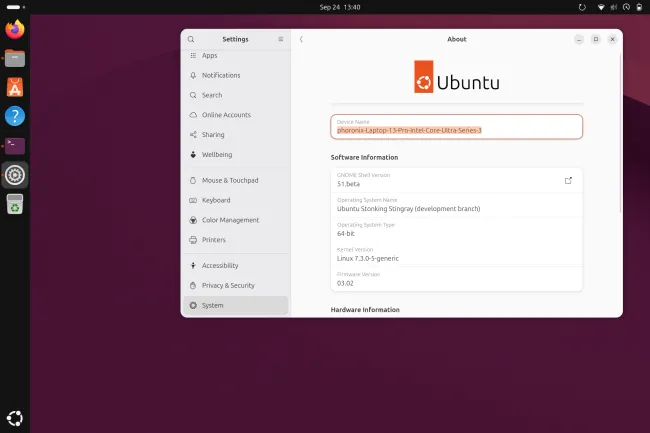
Among the most compelling advancements in Ubuntu 26.10 is the elevation of its default kernel from the initially slated Linux 7.2 to the formidable Linux 7.3. Although Canonical originally intended to deploy Linux 7.2, the remarkably smooth progression of upstream kernel development ensured that Linux 7.3 encountered no substantial delays. Consequently, Canonical decisively pivoted to embrace Linux 7.3, thereby empowering the new release with impeccably refined hardware support and cutting-edge kernel functionalities.
State-of-the-Art GNOME 51 and Graphics Stack
The desktop edition gracefully adopts the state-of-the-art GNOME 51 desktop environment. GNOME 51 introduces a plethora of refinements to desktop components and the overarching user experience. Building upon this exquisite foundation, Ubuntu continuously polishes its unique interface and system integration, establishing Ubuntu 26.10 as an exceptionally ambitious vanguard among contemporary Linux distributions in pursuing the latest GNOME and kernel innovations.
Within the graphics stack, the operating system proudly features the open-source Mesa 26.2 graphics drivers. The formidable synergy between Linux 7.3 and Mesa 26.2 holds profound significance for the next generation of AMD, Intel, and disparate GPU architectures. This potent combination specifically augments hardware compatibility for recently debuted processors and integrated graphics platforms.
For devices harnessing Intel’s latest generation of cost-effective processors, Ubuntu 26.10 already demonstrates performance capabilities that magnificently eclipse those of the Ubuntu 26.04 LTS. Previous benchmarking on the Intel Core 3 Wildcat Lake indicates that by revitalizing the kernel, Mesa, and ancillary software components, the new system grants these nascent platforms a tangible performance renaissance. Furthermore, this release meticulously optimizes support for next-generation hardware architectures, including Intel Panther Lake.
The Triumphant 100 Percent Rust Coreutils Migration
Another monumental transformation within Ubuntu 26.10 is the triumphant completion of the Rust Coreutils migration. Beginning with Ubuntu 25.10, Canonical progressively supplanted the traditional GNU Coreutils with the Rust-based uutils Coreutils. Previously, owing to lingering compatibility intricacies, quintessential commands such as cp, mv, and rm remained tethered to their GNU iterations. Upon the arrival of Ubuntu 26.10, these final foundational commands have unequivocally transitioned, achieving a flawless 100 percent Rust Coreutils environment. Consequently, traditional system operations, encompassing file replication, relocation, and deletion, are now intrinsically governed by their sophisticated Rust counterparts.
Canonical propelled this migration primarily to harness the unparalleled memory safety inherent to the Rust programming language. Legacy system components, historically forged in C, have perennially harbored the peril of memory security vulnerabilities. By meticulously rewriting core system utilities in Rust, the likelihood of such vulnerabilities is profoundly diminished. Nevertheless, preserving impeccable compatibility between Rust Coreutils and GNU Coreutils remained paramount, prompting Canonical to dedicate extensive efforts toward harmonizing behavioral discrepancies across varied commands.
Enhancing System Resilience and AI Integration
Moreover, Ubuntu 26.10 exquisitely refines the desktop system’s composure under intense memory duress. Whenever available system memory dwindles, Ubuntu proactively orchestrates resource management governed by prevailing memory pressures. This vigilant orchestration drastically mitigates the catastrophic risk of the entire desktop environment succumbing to severe stuttering or complete unresponsiveness due to memory exhaustion.
Artificial intelligence integration represents yet another captivating frontier for this release. Canonical is actively weaving seamlessly natural voice interaction capabilities into the Ubuntu desktop, meticulously constructing the infrastructure for speech-to-text functionalities and a future of context-aware computing. Following the developmental team’s introduction of the Myna speech-to-text initiative, Ubuntu 26.10 confidently lays the cornerstone for profoundly intelligent desktop interactions.
Optimizing Installation and ARM Hardware Support
In the realm of installation and onboarding, Ubuntu 26.10 introduces thoughtful recalibrations. Canonical steadfastly streamlines the system installation sequence and elegantly polishes the initial boot guidance experience. This noble endeavor aspires to dramatically lower the learning threshold for uninitiated Linux voyagers embarking upon their first Ubuntu journey.
Regarding hardware empowerment, Ubuntu 26.10 devotes particular reverence to the latest ARM notebook architectures. Canonical recently unveiled an Ubuntu Concept ISO meticulously tailored for Qualcomm Snapdragon X series processors, seamlessly introducing preliminary support for Snapdragon X2 notebooks while perpetually enhancing Snapdragon X1 compatibility. This strategic maneuver unequivocally signifies Ubuntu’s ambition to broadly expand its dominion over the burgeoning PC platforms heralding the Windows on Arm epoch.
The operating system also diligently advances the experimental provision of amd64v3 software packages. For contemporary processors fulfilling the x86-64-v3 instruction set prerequisites, Canonical endeavors to supply packages intrinsically optimized for modern CPU instructions, thereby thoroughly exploiting the latent hardware prowess of newer processors. Naturally, this feature presently dwells within an experimental realm, meaning not all Ubuntu inhabitants will default to the amd64v3 packaging paradigm.
Anticipating the Final Stable Release
The developmental cadence of Ubuntu 26.10 faithfully echoes Ubuntu’s cherished bi-annual release rhythm. Following the Beta phase, Canonical intends to cross the threshold into the final freeze on October 8, culminating in the preparation of release candidates before the grand unveiling of the ultimate stable version on October 15.
In stark contrast to the Ubuntu 26.04 LTS unveiled in April, Ubuntu 26.10 does not reign as a Long-Term Support release; rather, it vehemently champions technological rejuvenation and the audacious validation of novel features. Consequently, Canonical vigorously embraces the absolute latest Linux kernel, GNOME environment, Mesa drivers, and Rust system components, meticulously cultivating the fertile soil for the next generation of the Ubuntu technology stack.
The Beta currently offers a diverse tapestry of installation images, encompassing both AMD64 desktop and server editions, whilst official derivatives such as Kubuntu, Lubuntu, Ubuntu Budgie, Ubuntu Studio, Ubuntu Unity, and Xubuntu sequentially present their own Beta manifestations. For the everyday user, this Beta primarily serves as a sanctuary for testing and developmental exploration. It is sternly discouraged for deployment within mission-critical production environments demanding unwavering stability. Given that Linux 7.3 remains entrenched in its integration phase preceding the final release, distinct drivers, third-party software, and hardware compatibilities may yet endure transformative shifts.
Assuming the final release faithfully adheres to the prevailing developmental trajectory, Ubuntu 26.10 will unequivocally emerge as one of the most technologically sweeping non-LTS iterations in recent memory. The monumental confluence of Linux 7.3, GNOME 51, Mesa 26.2, the absolute 100 percent Rust Coreutils migration, and triumphant support for nascent Intel, ARM, and diverse hardware platforms collectively forge the technological crescendo of this majestic release. The stable incarnation is eagerly projected to grace the world officially on October 15.