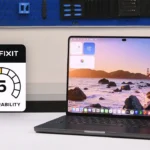

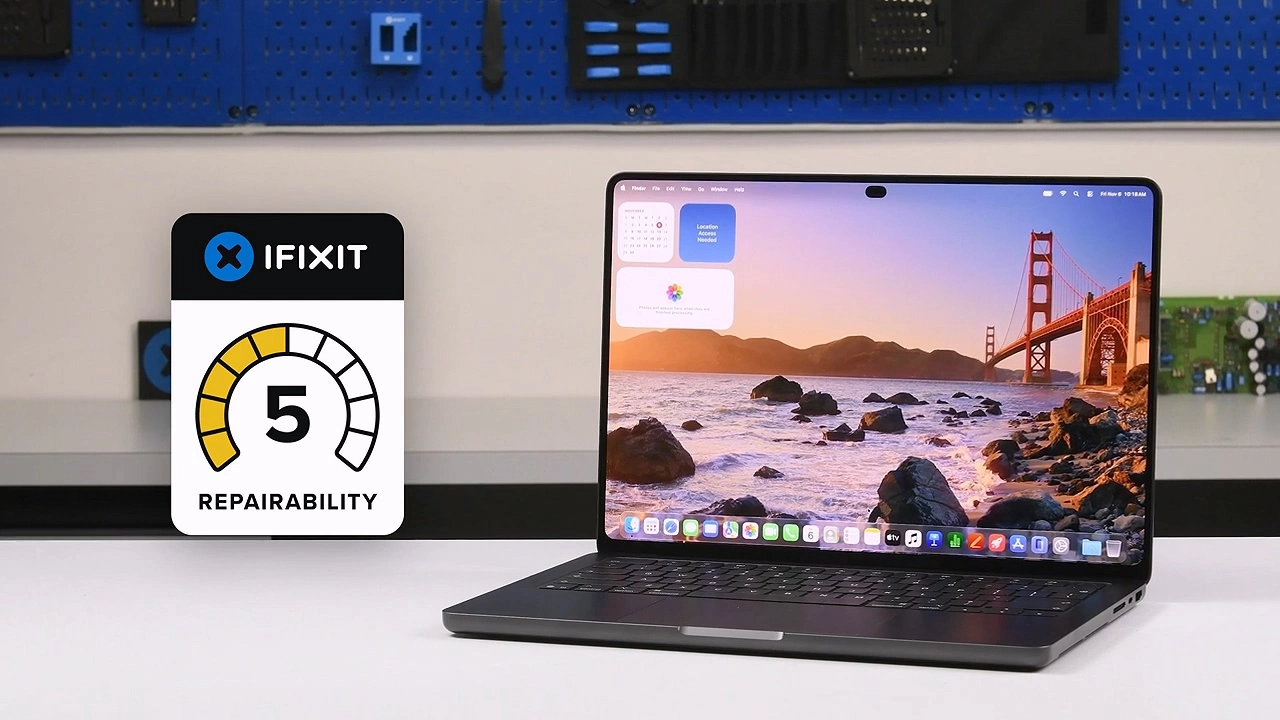
Reaching the glowing Apple logo on Apple’s first touchscreen MacBook Pro means going through the OLED screen. Repair company iFixit found that out the hard way. Its team cracked the panel while trying to get to the four LEDs that light the logo, according to its teardown of the 14-inch MacBook Pro with PROLED XDR.
The laptop still earned a repairability score of 5 out of 10. That is one point higher than last year’s M5 MacBook Pro. iFixit also released a video version of the teardown, as 9to5Mac noted in its coverage.
How the glowing logo works
The new model uses a tandem OLED panel. OLED pixels make their own light, so there is no backlight to shine through the logo. Older MacBooks lit the logo with the screen’s backlight, so Apple needed a new method here.
iFixit found an LED strip with four LEDs along one edge of the logo. Their light bounces off a reflective layer and passes through a diffuser. The result is an evenly lit apple. Two foam pads sit on either side of the logo, which iFixit says likely give support when someone presses on the glass.
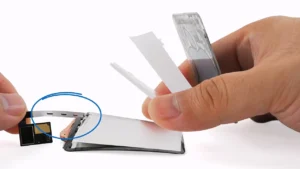
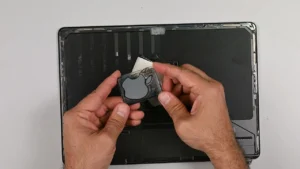
With the LEDs off, the logo looks like shiny metal. iFixit describes a “mirror-like coating that looks shiny with the lights off.” MacRumors and 9to5Mac call it a two-way mirror coating.
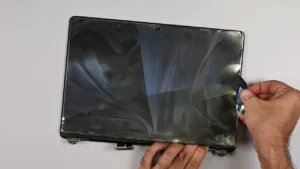
The trouble is location. The LED strip sits behind the display. The panel would not come out in one piece. Heat and prying lifted the rubber trim, then the glass separated from the layers beneath it. That cracked the OLED and the touch layers. iFixit called it “an insane repair path for reaching the glowing logo.”
What changes for buyers and repair shops
For owners, the logo is the clearest new repair risk. MacRumors notes that because the logo sits behind the display, fixing it requires removing the screen. iFixit expects the lid to cost more than the one on non-touch models, though Apple has not listed prices yet.
Parts you can replace, and the catch
- The fans can be replaced, but they sit under the logic board.
- The Thunderbolt/USB-C ports are on modular boards. Swapping them still requires removing the logic board.
- One of the headphone jack’s screws also sits under the logic board.
- MagSafe comes out with two screws and a bracket.
- The battery uses pull tabs, but iFixit found them hard to remove intact.
- Four pentalobe screws hold the bottom cover.
Parts that stay soldered
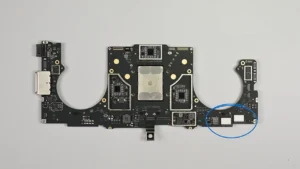
Storage and unified memory are soldered to the logic board. So are the HDMI port and the SDXC card reader. The keyboard is built into the aluminum top case. By contrast, iFixit notes that the MacBook Neo’s keyboard can be replaced on its own. MacRumors and 9to5Mac report that the PROLED model scores one point below the MacBook Neo.
For buyers, this means the memory and storage you pick at checkout are what you keep. There is no later upgrade path inside the machine.
Good news on parts pairing
iFixit swapped logic boards between two PROLED MacBook Pros. On first boot, Apple’s Repair Assistant recognized the battery, display and Touch ID sensor. The touchscreen, True Tone and brightness control all worked without a separate calibration step.
Touch ID enrolled a fingerprint with the donor board. It kept working after the original board went back in. Last year’s M5 MacBook Pro failed that Touch ID calibration. In other words, the touchscreen did not add new parts-pairing locks.
Where Apple cut the weight
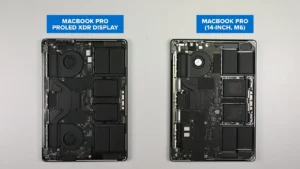
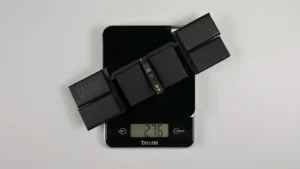
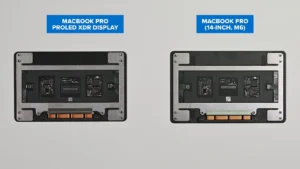
Apple says the 14-inch model weighs 3 pounds, half a pound less than before, in its launch announcement. iFixit measured 1.38 kg, which is 170 grams lighter than the base 14-inch M6 MacBook Pro. Most of the savings came from less aluminum in the bottom case and a lighter display, even with touch and the lit logo added.
| Part | 14-inch PROLED | Base 14-inch M6 |
|---|---|---|
| Whole laptop | 1.38 kg | 1.55 kg |
| Bottom case with cover | 364 g | 456 g |
| Display assembly | 384 g | 485 g |
| Battery | 276 g (72.6 Wh) | 278 g |
| Speakers | 39 g | 29 g |
| Trackpad | 8 g lighter, slightly smaller | – |
The speakers are the one part that got heavier. Apple claims the redesigned woofer delivers 50 percent deeper bass.
The hinge claim
Apple says “a newly designed hinge provides greater stability while using Touch.” iFixit found the hinges nearly indistinguishable from the M6 model’s. The PROLED lid wobbles a little less, likely from minor spring tuning, and iFixit called the change “definitely mainly hype.” MacRumors describes the hinge as stiffer. iFixit found no lid-angle sensor and no link to rumored iPhone Duo hinge technology.
Inside the tandem OLED display
This section covers the deeper display details. Apple’s panel stacks two light-emitting layers. That lets it hit the same brightness with less current per layer, or reach a higher peak. Apple rates it at up to 2,000 nits, with ProMotion refresh rates from 10Hz to 120Hz.
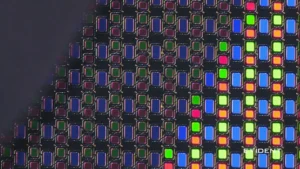
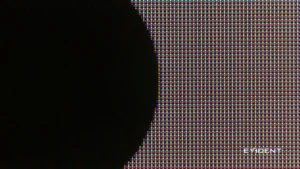
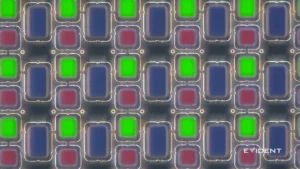
Under a microscope, iFixit saw that the blue subpixel is much larger than the red and green ones. Blue OLED materials wear out faster. A larger blue area spreads the load, which reduces strain on each unit of material. The older M5 LCD, by comparison, uses red, green and blue filters over a backlight.
Prices and models
Apple announced the MacBook Pro with PROLED XDR on October 28, 2026, and it went on sale November 6. It comes in 14-inch and 16-inch sizes with M5 Pro or M5 Max chips. U.S. prices start at $2,899 for the 14-inch M5 Pro and $3,399 for the 16-inch M5 Pro. M5 Max models start at $4,499 and $4,799. iFixit tore down only the 14-inch model.
What remains unclear
- Repair part prices: Apple had not listed Self-Service Repair parts or prices when iFixit published.
- A separate logo fix: No source says whether Apple will offer the logo LED strip as its own part, or if a shop must replace the whole lid.
- The 16-inch model: iFixit did not open it, so its weights and layout are unconfirmed.
- Future scores: iFixit says the laptop would drop to 4 out of 10 under its 2027 scoring rules, which deduct more for soldered memory.