
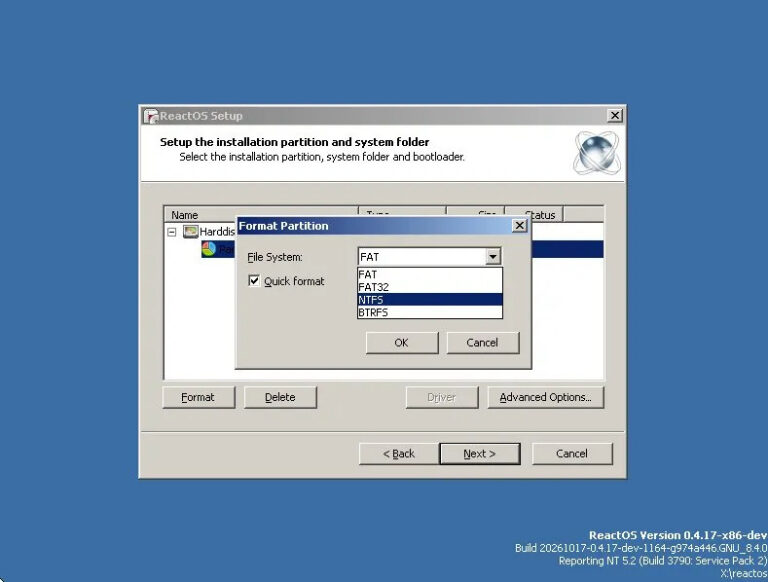
Technology outlet Ars Technica published a report today, October 20. They detailed a major update for the open-source operating system project, ReactOS. This project now supports direct system installation onto NTFS disk partitions. Developers achieved this by introducing a brand new NTFS file system driver.
What is ReactOS?
A passionate volunteer community drives the open-source ReactOS initiative. Its primary goal involves recreating the classic Windows operating environment. Consequently, it offers deep compatibility with traditional Windows applications and drivers. Furthermore, it fundamentally reimplements core Windows system capabilities. The project successfully celebrated its 30th anniversary in January 2026.
Breaking the FAT32 Barrier
Previously, users had to reserve a dedicated FAT32 partition just to install ReactOS. Meanwhile, NTFS has served as the standard file system for mainstream Windows environments since the Windows XP era. Therefore, this older FAT32 restriction severely hindered the overall practicality and deployment convenience of ReactOS.
The publication noted that this NTFS support did not happen overnight. In fact, the project initially incorporated read-only NTFS support back in 2016. Later, in 2022, its FreeLoader bootloader successfully gained the ability to boot directly from NTFS partitions. However, the arrival of this new driver finally allows users to install the actual operating system onto an NTFS partition. Ultimately, this milestone fills a critical gap that existed for nearly a decade.
Current Limitations and Future Plans
Nevertheless, everyday users should avoid using this as a daily Windows substitute. The ReactOS team explicitly stated that the new driver currently lacks caching mechanisms. As a result, its performance remains quite poor. Additionally, it does not support essential journaling features or robust file system security protocols. Furthermore, undiscovered bugs might still lurk within the code.
For the broader open-source community, developers can finally install ReactOS on the exact same file system as real Windows. Consequently, this breakthrough paves the way for advanced compatibility testing and seamless dual-boot deployments. It also enables development in scenarios that closely mimic real-world usage. The project team also emphasized that this progress brings them one step closer to releasing a highly anticipated Beta version.
Transitioning to Modern Architectures
Beyond simply supporting NTFS disk partitions, ReactOS recently eliminated the obsolete “Documents and Settings” user directory. Instead, the system now adopts the modern “Users” directory structure. Gradually, it is initiating a broader transition toward the robust Windows NT 6 architecture.
This significant shift means the project, which fans often call the open-source Windows, is finally evolving. Windows XP famously represented this older NT 5 era. Now, the software approaches the modern NT 6 architecture. This foundation underpins Vista, Windows 7, 8, and subsequent modern Windows iterations.