

RFdiffusion3 AI System Transforms Protein Design at the Atomic Level
Researchers recently unveiled the detailed design scheme for RFdiffusion3. This generative artificial intelligence system constructs proteins and nucleic acids atom by atom. Moreover, proteins crafted through this new system successfully perform intended functions during actual chemical reactions.
An international research team built this precise atomic modeling tool. Members include scientists from the University of Washington, Oxford University, and Nvidia. They published their groundbreaking findings in the prestigious journal Science on October 16. You can read the detailed research paper here: https://www.science.org/doi/10.1126/science.aeh2982.
The Evolution of Protein Engineering
Previously, the research team open-sourced the RFdiffusion3 project on December 3, 2025. Now, the recent publication thoroughly explains its core design principles. Consequently, AI-driven protein research has shifted paradigms. Scientists have moved beyond merely predicting existing protein structures. Today, they actively design entirely new proteins with specific structures and functions.
Professor David Baker from the University of Washington serves as the corresponding author. He previously won the 2024 Nobel Prize in Chemistry for his computational protein prediction work. Furthermore, one of his landmark achievements is the RosettaFold AI system.
Building on Previous Successes
RosettaFold effectively learns the spatial relationships between amino acids. It then uses this critical information to predict complex 3D structures. Consequently, developers built both RFdiffusion1 in 2023 and RFdiffusion2 in 2025 upon the RosettaFold network.
These systems use diffusion models to position amino acids accurately. Ultimately, this allows them to finalize intricate protein designs. Diffusion models represent a unique class of AI. They learn data distribution patterns to generate entirely new outputs.
How RFdiffusion3 Enhances Precision
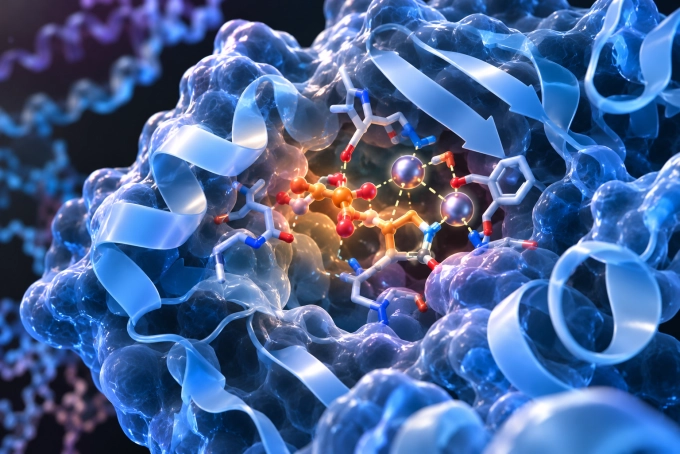
Developers heavily referenced the AlphaFold3 network architecture when creating RFdiffusion3. This advanced system represents a single amino acid using up to 14 atoms. By directly adjusting the 3D coordinates of each atom, it designs unprecedented protein structures.
Therefore, the research team successfully designed precise enzyme active sites. Enzymes act as essential biological catalysts. They significantly accelerate various chemical reactions within living organisms.
Mastering Complex Chemical Constraints
Researchers can now specify exact atom locations for reactions. They also define hydrogen bond formations and specific atomic distributions. Subsequently, RFdiffusion3 generates a complete protein structure that perfectly satisfies every constraint.
The team evaluated the system using 41 existing enzyme active sites. Impressively, RFdiffusion3 outperformed its predecessor in 37 of these rigorous tests. Furthermore, it generates these structures about ten times faster than RFdiffusion2.
In real-world laboratory experiments, newly designed enzymes successfully executed their expected chemical reactions. Ultimately, the research team expects wide adoption of RFdiffusion3 across various biomolecular design tasks.