
Sony’s new fall detection system needs no camera, no wristband and no pendant. It watches for falls by reading changes in ordinary Wi-Fi signals. The company says it captures no images at all, which makes it suited to bedrooms and bathrooms.
Sony (China) showed the system as a global debut at the 9th China International Import Expo (CIIE) in Shanghai, which runs from November 5 to 10. China Daily’s report on multinational debuts at the expo lists it among seven global premieres Sony brought to the show, along with five China debuts.
The system is not on sale yet. It is still in a pilot stage in Shanghai.
What Sony showed at the expo
Sony describes the product as a privacy-friendly wireless sensing system for home-based elderly care. It targets homes, especially bedrooms and bathrooms, as well as nursing institutions and community care services.
When it detects a fall, the system can sound a local alarm with lights. It can also push an alert to caregivers through an app or a mini-program.
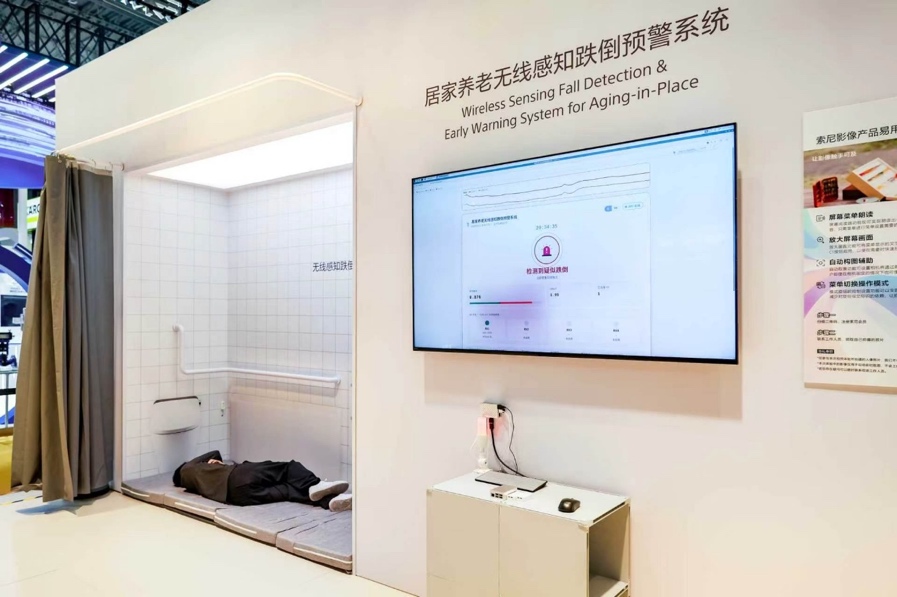
According to Mydrivers’ report, republished by Sina Tech, the booth demo used a mock bathroom. Alerts appeared on a TV screen mounted on the wall. The same report says the system starts monitoring once it is powered on.
Sony China Research Institute developed the system in-house. Mydrivers adds that Sony worked with the University of Science and Technology Beijing on it.
Takeshi Yoshida, corporate vice-president of Sony Group and president of Sony (China), told China Daily that Sony wants to deepen local cooperation through the expo. He said the company aims to combine its creativity and technology with the needs of the Chinese market.
How Wi-Fi can notice a fall
A person moving through a room changes how Wi-Fi signals travel. Their body blocks, bends and reflects the radio waves. A fall creates its own pattern of change.
Sony’s setup has three parts: a Wi-Fi signal transmitter, a receiver and a data processor. The processor reads the signal changes and decides whether a fall just happened.
The technical details
The system collects channel state information, or CSI. CSI is fine-grained data on how a signal changes between the transmitter and the receiver. Sony combines this data with human motion features and deep learning models to recognize fall events.
Sony says the system can detect common fall types, including slow falls and slips. It supports single-person detection only, based on Sony’s description.
What changes for families and care homes
The pitch is simple. An older person does not have to wear or charge anything. The system also records no video of private rooms.
For care homes, that could mean fall alerts without adding more camera monitoring for staff to watch. Sony frames the system as a way to help caregivers notice falls quickly and respond in time.
The single-person limit matters in practice. A shared room or a busy family home is a different case from a person living alone. Sony has only confirmed detection for one person.
Here is what the sources confirm so far, and what is still missing:
| Question | What Sony has said |
|---|---|
| Camera or images | None; no image capture |
| Wearable needed | No |
| Hardware | Wi-Fi transmitter, receiver, data processor |
| Fall types | Common falls, including slow falls and slips |
| People tracked | Single person |
| Alerts | On-site sound and light, app or mini-program |
| Status | Pilot in Shanghai |
| Price | Not disclosed |
| Accuracy figures | Not disclosed |
| Launch date or markets | Not disclosed |
A second year of camera-free fall sensing at CIIE
This is not Sony’s first fall product at the expo. At the 8th CIIE in 2025, City News Service reported that Sony debuted an AI-driven fall detection sensor that tracks movement without capturing images.
The new system keeps the same privacy goal. The big change is the sensing method, which now relies on Wi-Fi signals.
What Sony has not said yet
Several key questions remain open. Sony has not shared any accuracy numbers, such as how often it misses a fall or raises a false alarm. The Shanghai pilot is still verifying stability and detection accuracy in real use, according to Mydrivers.
There is also no word on price or a release date. Sony has not said whether the system will reach markets outside China.
Another unknown is the sales model. Sony has not said whether families will buy the hardware, or whether care operators will offer it as a service. It is also unclear how well the system copes with more than one person in a room.
For now, the system is best seen as a caregiver alert tool in testing. It is not a replacement for in-person care or medical monitoring. Families who need fall alerts today will still have to look at existing products.