Apple HomeView smart home display with A18 chip and Liquid Retina screen
#AppleHomeView #SmartHome #AppleIntelligence #HomeKit #SiriAI
Apple Launches $299 HomeView Smart Home Display Powered by A18 Chip
Apple has officially unveiled the Apple HomeView, an innovative smart home management device. Both the standard tabletop model and the wall-mounted variant retail for $299. Pre-orders begin today in initial launch markets, including the United States, the United Kingdom, Australia, Canada, India, and New Zealand. Furthermore, customers in Singapore can pre-order the device starting October 15. Official retail availability across all supported regions will commence on November 13.
Core Hardware and Display Specifications
Under the hood, the Apple HomeView runs on the powerful A18 chip. It features a 7-inch (6.98-inch diagonal) Liquid Retina IPS display with a 1088×1088 pixel resolution at 220 ppi. Additionally, the screen supports True Tone technology and includes an anti-fingerprint oleophobic coating. For video communication and home monitoring, the device integrates a 12-megapixel camera with an f/2.4 aperture. It seamlessly combines music playback, FaceTime calls, security monitoring, and smart home control with an upgraded Siri AI powered by Apple Intelligence. Connectivity options include Wi-Fi 6E, Bluetooth 6.0, and Thread. However, users must pair the hub with an iPhone running iOS 27.2 or later, or an iPad running iPadOS 27.2 or later.
Industrial Design and Mounting Options
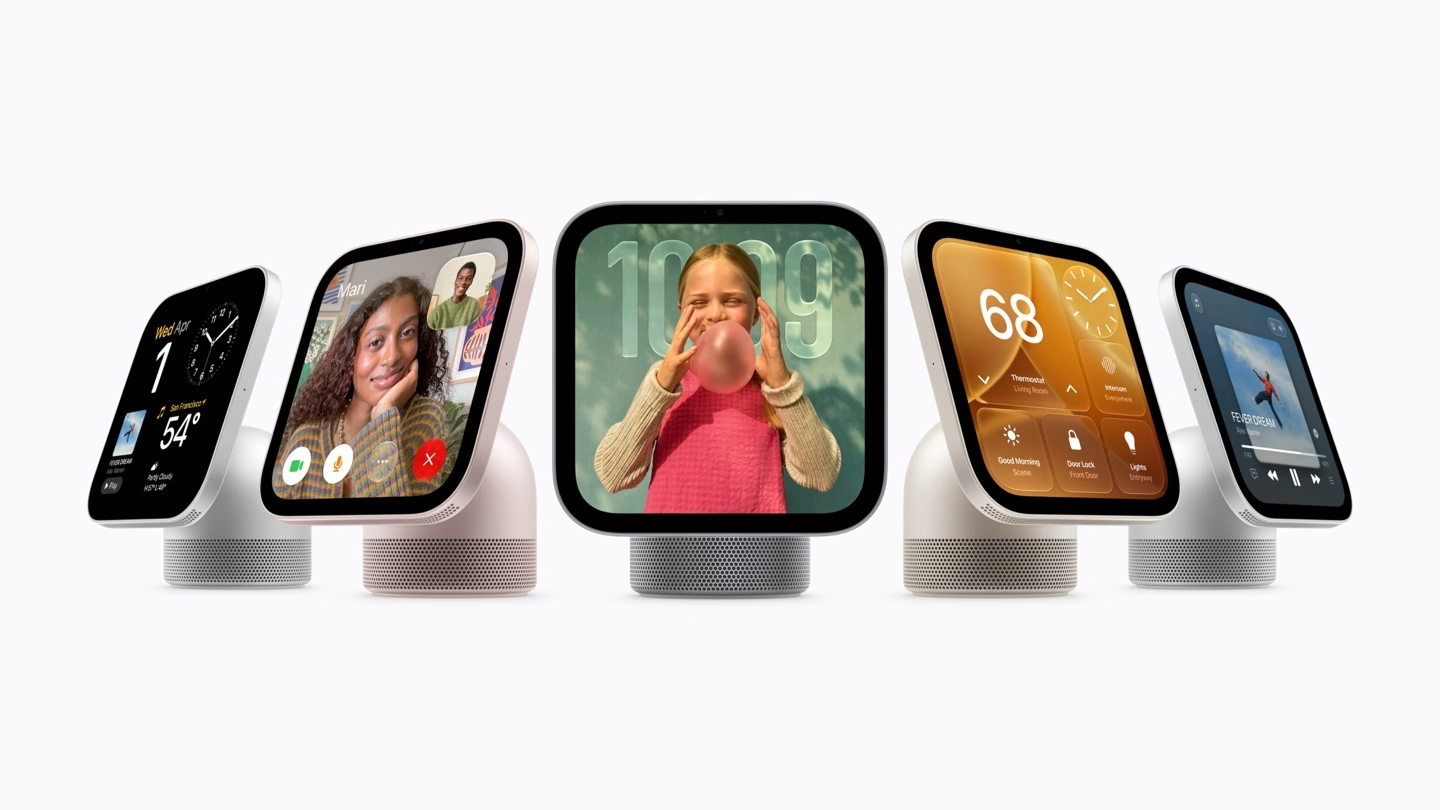
The standard HomeView features a sleek aluminum enclosure. A stainless steel hinge connects the display to a hemispherical speaker base, allowing users to tilt the screen easily. Moreover, buyers can choose from four distinct finishes: Silver, Starlight, Rose Pink, and Space Gray, each bundled with a color-matched cable.
Meanwhile, the wall-mounted version comes in Space Gray and Silver. Users can install it independently or professionally using three specialized mounts from Schneider Home. Specifically, the Power Mount USB-C Wall Connector starts at $59.95, while the Power Mount AC Wired costs $79.95; both are available to order today. Additionally, the Power Mount PoE Wired will launch in early 2027 for $129.95.
Adaptive Interface and Audio Architecture
The HomeView display offers adaptive color temperature and automatic brightness ranging from 0.3 nits to 500 nits. Consequently, the interface intelligently adjusts information density based on the user’s distance from the screen. For customization, the system provides several watch-face-style layouts. These include a Photos face with portrait depth effects and a dynamic Flow face that responds to physical movement. Users can also enjoy an animated Snoopy face that reacts to the time, weather, sporting events, and holidays. Alternatively, families can select shared albums to transform the hub into a digital photo frame.
Regarding acoustics, Apple integrated four beamforming microphones and two custom full-range drivers directly into the display module. Furthermore, the tabletop base houses a downward-firing subwoofer alongside two force-canceling passive radiators. Computational audio technology optimizes sound performance in real time according to volume levels. Although the wall-mounted model lacks a base, it utilizes dual drivers and computational audio specifically tuned for wall surfaces. The hub supports Apple Music, Apple Podcasts, Apple News, Apple TV, and compatible third-party media apps. Users can also transfer music from an iPhone via Handoff or group the unit with HomePod speakers for multi-room audio with Dolby Atmos spatial audio.
Smart Home Control and Daily Communication
For household communication, HomeView supports FaceTime with Center Stage, voice replies for Messages, and an on-screen keyboard. Families can broadcast voice announcements to specific rooms using the Intercom feature. In the kitchen, the device converts web recipes into step-by-step instructions with hands-free timers and ingredient tracking. Live Activities also display current songs, active timers, and incoming intercom alerts.
As a central command hub, HomeView lets users view camera feeds, adjust thermostats, dim lights, lock doors, and close blinds via touch or Siri AI. The Home Camera view displays up to nine live video streams simultaneously. When paired with an iCloud+ subscription and compatible cameras, end-to-end encryption enables the hub to identify people, pets, packages, and vehicles. Furthermore, the system generates text descriptions for HomeKit Secure Video clips and listens for smoke or carbon monoxide alarms, sending instant alerts to linked Apple devices.
Alongside the hub, Apple introduced the Apple Home Collection, a suite of cameras, thermostats, and smart locks co-developed with LG Electronics and Schneider Electric. The device also supports Works with Apple Home and Matter accessories.
Personalized Recognition, Privacy, and Regional Availability
The device utilizes facial recognition to switch personalized content for up to six family members while keeping privacy at its core. Once it recognizes a user, it displays their personal data across Messages, FaceTime, Calendar, Reminders, and Find My. However, private information remains strictly inaccessible to other household members. Greg Joswiak, Apple’s Senior Vice President of Worldwide Marketing, noted that HomeView is designed to be shared by everyone at home while feeling completely personal to each individual.
When paired with an Apple Intelligence-enabled iPhone or iPad, Siri AI accesses personal context across Calendar, Messages, and Apple Music to execute cross-app tasks. Conversations can transition smoothly from HomeView to the Siri app, syncing privately via iCloud across Apple devices. To safeguard privacy, the A18 chip utilizes Secure Exclaves to isolate camera and microphone data from the rest of the operating system. Apple emphasizes that neither apps nor the company can access data processed inside Secure Exclaves. Personal content only appears when the hub recognizes an enrolled face and detects their recently unlocked iPhone or iPad nearby. Siri requests run locally or via Private Cloud Compute.
Finally, Apple confirmed that HomeView will not launch in the European Union because Siri AI remains unavailable on iOS in the region. Apple is currently working with EU regulators to find a solution. At launch, Siri AI on HomeView supports English in the US, Australia, Canada, India, New Zealand, Singapore, South Africa, and the UK, with Canadian French arriving via a future software update.