Google Releases Gemini 4 Argon Globally With 1 Million Token Context Window
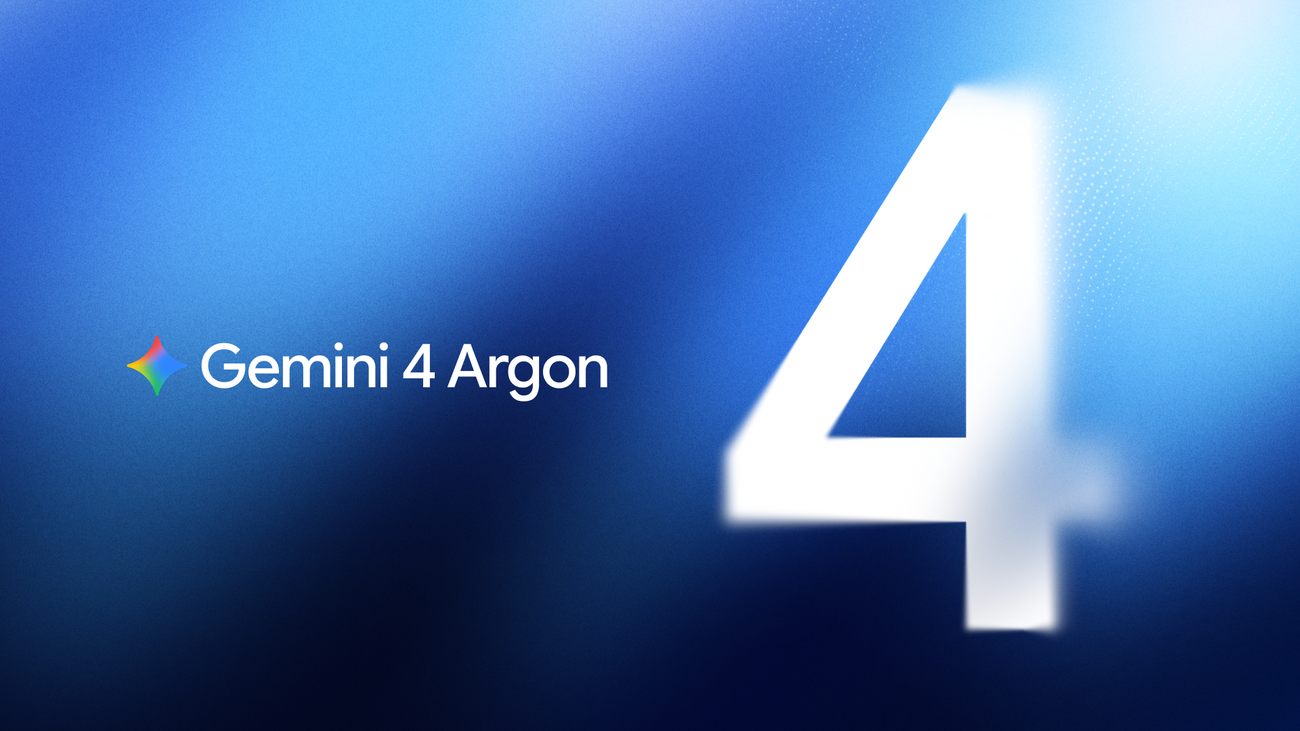
Google has officially launched Gemini 4 Argon for developers and enterprises worldwide. Users can now access the frontier model through Google AI Studio and the Gemini platform API. Additionally, the rollout extends to Google AI Ultra subscribers using Google Antigravity, alongside Google AI Ultra and Pro subscribers across the Gemini app and Search AI Mode.
Introductory and Standard API Pricing
Currently, Google offers limited-time introductory pricing for developers integrating the model into their applications:
- Input: $2.00 per million tokens
- Output: $10.00 per million tokens
- Cached Input: $0.10 per million tokens
However, once this promotional period concludes on November 30, 2026, standard rates will take effect:
- Input: $4.00 per million tokens
- Output: $20.00 per million tokens
- Cached Input: $0.20 per million tokens
Leading Performance Across Enterprise Benchmarks
Gemini 4 Argon excels at handling intricate, real-world workflows across software engineering, finance, law, cybersecurity, and scientific research. Specifically, its depth and precision in multi-step reasoning allow it to outperform competing frontier models on numerous industry benchmarks. Notably, the model currently ranks first on the Vals Index, which evaluates artificial intelligence performance across critical economic sectors including finance, coding, legal analysis, and taxation.
Both internal Google divisions and external enterprise research teams already utilize the model to solve complex challenges. These applications include refactoring massive codebases, streamlining legal and financial workflows, identifying critical cybersecurity vulnerabilities, and accelerating breakthroughs in quantum computing, nuclear fusion, and the life sciences.
Engineering Breakthroughs and Scientific Access
In software engineering, Gemini 4 Argon assisted the Chrome team in refactoring tens of millions of lines of code. Consequently, the model compressed a monumental architectural overhaul from several months into a matter of weeks. Furthermore, it autonomously optimized an open-source project overnight, reducing in-memory session preparation time by 40% and boosting cold import speeds by 21%.
To support academic discovery, Google is granting 10,000 scientists six months of complimentary access to the highest usage tier of Google Antigravity, with applications open today. In the cybersecurity sector, the company expanded its Project Fairwind partnerships to help more defenders discover and patch software vulnerabilities using the model.
Enhanced Safety Architecture and Token Capacity
Regarding safety, Google deployed a multi-layered defense architecture for Gemini 4 Argon. This framework delivers substantial improvements in jailbreak resistance, prompt injection protection, and agentic alignment monitoring. As a result, the violation rate for harmful requests dropped by nearly half compared to previous-generation Gemini models.
Finally, in terms of capacity, Gemini 4 Argon supports long-form decoding outputs of up to 1,048,576 tokens (approximately 1 million tokens). However, input prompts, internal reasoning tokens, and generated outputs all share this unified 1-million-token context window.