

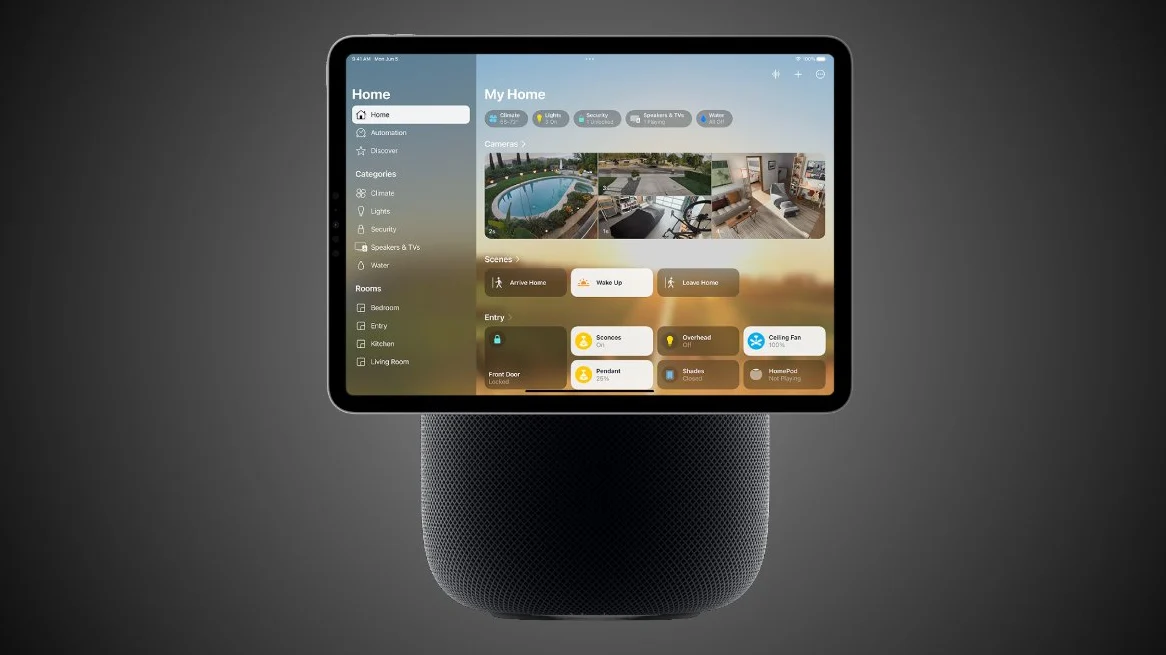
Apple Smart Home Hub: Design and HomeOS Details
Technology publication MacRumors published an illuminating report today, October 1, meticulously compiling existing leaks regarding the highly anticipated Apple smart home hub. Experts anticipate an October 13 unveiling for this sophisticated device. It boasts an elegant six-inch display and debuts in both wall-mounted and desktop configurations.
Innovative Physical Architecture
Regarding its physical design, the manufacturer will offer a wall-mounted iteration, internally designated as J491, alongside a desktop version, codenamed J490. Both exquisite models feature an approximately six-inch square display, elegantly framed by a quarter-inch black bezel. The desktop variant prominently evokes the iconic silhouette of the classic iMac G4. It features a circular metal base and a robust metal arm connecting the screen, allowing users to manually adjust the viewing angle. Furthermore, the chassis utilizes a refined gray aluminum exterior and draws sustained power through a standard USB-C port.
Observers fondly recall the original iMac G4, an all-in-one desktop computer released between 2002 and 2004. Characterized by its pristine white hemispherical base and gleaming chrome adjustable arm, enthusiasts affectionately christened it the “lamp iMac.”
Wall-Mounted Configuration and Sensors
Conversely, the wall-mounted edition features a slender, square base positioned beneath the screen to house the advanced speaker and microphone array. A sturdy metal arm facilitates smooth forward and backward tilting. Additionally, both sophisticated configurations incorporate a high-definition 1080p front-facing camera. Engineers exquisitely optimized this lens for FaceTime communications, secure biometric authentication, and precise facial recognition.
Notably, neither product contains an internal battery, thereby requiring continuous tethering via a USB-C connection. Sophisticated proximity sensors intelligently discern the user’s distance. When the room is vacant, the ambient display gracefully presents basic information such as the current temperature. However, upon sensing an approaching individual, it seamlessly transitions into an interactive control interface. This advanced human presence detection can also initiate seamless home automation, such as illuminating a room upon entry. Furthermore, it supports intuitive gesture recognition for effortless long-distance operation.
The HomeOS Digital Ecosystem
Regarding its digital ecosystem, insiders suggest the device operates on a proprietary system internally christened “Charismatic.” Upon its official debut, the manufacturer may formally unveil it as homeOS. This innovative platform harmoniously blends distinct elements from tvOS, watchOS, and iOS. The user interface heavily echoes watchOS and the iPhone StandBy mode. During idle periods, it prominently showcases elegant clock faces and curated photographic slideshows. Meanwhile, the primary home screen iconography closely mirrors the familiar Apple Watch aesthetic.
Hardware and Application Strategy
To flawlessly support the demanding computational needs of Apple Intelligence, industry experts anticipate the integration of an A18 processor or a superior silicon architecture. Consequently, the device will certainly feature a minimum of eight gigabytes of advanced memory.
Currently, the technology giant harbors no immediate plans to curate a dedicated App Store specifically for this smart home nexus. Instead, the device will arrive with essential pre-installed applications, including Safari, Apple Music, Photos, Calendar, Messages, Reminders, and FaceTime.
Addressing biometric security and privacy, the integrated camera lacks the profound precision of traditional Face ID. Therefore, the system bolsters security through supplementary voice authentication. Moreover, users can conveniently leverage their iPhone for secondary verification to elevate overall security protocols, while an accessible guest mode safely conceals sensitive personal information.