
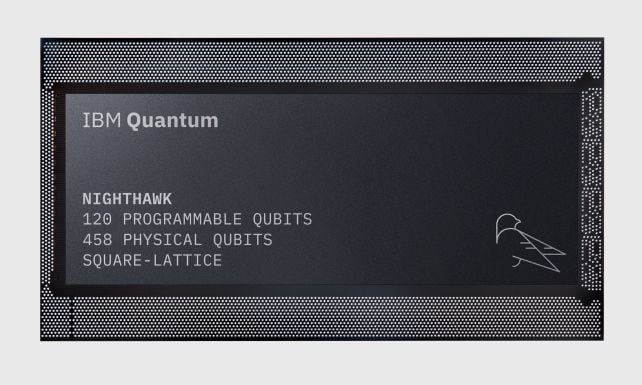
IBM Nighthawk r2 Achieves Remarkable Sampling Milestone
On September 30, reports indicated that the American BlueQubit research team successfully executed a random quantum circuit sampling experiment utilizing IBM’s latest quantum processor. Astonishingly, they generated one million samples in a mere nineteen seconds. BlueQubit researchers estimate that replicating this identical task on the mighty Frontier supercomputer would require approximately 110 years of continuous calculation.
Harnessing Superconducting Qubits
The Nighthawk r2 is an extraordinary superconducting quantum processor boasting 120 qubits, readily accessible via the IBM cloud platform. The research team deliberately selected 61 of these qubits to run random quantum circuits of escalating complexity, executing operations up to forty cycles. Ultimately, they discovered the optimal equilibrium for their experiment at thirty-six cycles, utilizing 918 two-qubit gates.
Under this precise configuration, the processor completed one million sampling iterations in just nineteen seconds. The critical triumph here is not merely the rapid generation of countless zeros and ones. Rather, it is the fact that these outcomes perfectly adhere to a specific probability distribution dictated by the quantum circuit – a profound phenomenon that remains exceptionally difficult for classical computers to replicate.
The Challenge for Classical Computers
Random Circuit Sampling (RCS) serves as a foundational benchmark task within the quantum computing realm, explicitly designed to evaluate the true prowess of quantum processors. Researchers compel the qubits to evolve and entangle through multiple rounds of randomly selected operations. This is followed by repeated measurements to yield extensive strings of binary results. As the quantity of qubits and operational rounds escalates, the difficulty for classical computers to calculate the corresponding probability distribution amplifies exponentially.
To estimate the staggering computational burden required for a classical computer to accomplish this exact same task, the research team employed a tensor network contraction methodology. The meticulous calculations revealed that reproducing these one million sample sets would necessitate approximately 1.2 x 10^27 computational operations.
Comparing Against the Frontier Supercomputer
Subsequently, the researchers utilized the formidable Frontier supercomputer as a baseline for their estimations. Frontier boasts a peak performance exceeding 10^18 operations per second. Based on the team’s sustained performance estimations, completing the equivalent task would demand roughly 110 years. Naturally, this 110-year figure is an estimation derived from a specific classical simulation algorithm, rather than the absolute theoretical limit of time required for a classical computer to execute the task.
Validating Quantum Results
To validate the outcomes generated by the quantum processor, the researchers implemented two ingenious cross-validation techniques. The first approach involved constructing “tailored” quantum circuits, fragmenting the 61 qubits into three or four smaller systems. This technique allowed classical computers to precisely simulate distinct segments of the circuit, which researchers then used to evaluate the results of the comprehensive experiment.
The second method utilized elegant mirror circuits. This instructed the quantum processor to execute a sequence of operations and immediately follow them with their exact inverse. If the quantum processor functioned flawlessly, the final state should revert precisely to the initial state. Therefore, any measured deviation eloquently reflects the noise and errors accumulated during the experimental process. Both methodologies continued to yield remarkably congruent results even as the circuit depth increased.
Under the experimental parameters of thirty-six cycles, the fidelity of the residual quantum signal hovered around 0.23 percent. This specific metric should not be interpreted simply as a conventional “accuracy rate.” Because a majority of the quantum information gradually dissipates due to noise during the random circuit sampling process, the experiment simply needs to ascertain whether the ideal quantum probability distribution still leaves a discernible, measurable imprint.
Hardware Advancements Accelerate Research
The sophisticated hardware architecture also played a pivotal role in drastically curtailing the experimental duration. Compared to IBM’s previous generation Heron processor, this newly minted processor incorporates a specialized reset mechanism that actively dissipates energy from the qubits. This brilliant innovation slashes the latency between consecutive experimental runs to a minimum of approximately one microsecond.
IBM declared that this processor can execute over 100,000 quantum circuits per second, standing in stark contrast to the Heron’s capacity of approximately 4,000 per second. This remarkable acceleration enables the rapid culmination of random quantum circuit sampling experiments that demand extensive, repetitive execution.
The Evolving Frontier of Quantum Supremacy
However, the research team did not proclaim that quantum computers have rendered classical supercomputers obsolete. The 110-year figure relies heavily on a specific tensor network simulation method and associated academic assumptions. The advent of more efficient algorithms, the recycling of intermediate computational results, and other sophisticated approximation techniques could substantially diminish the time required for classical computation.
A parallel scenario previously unfolded during Google’s famous 2019 Sycamore experiment. At that time, researchers initially estimated that a classical supercomputer would require nearly 10,000 years to complete the corresponding task. Yet, more efficient simulation methodologies subsequently emerged within the classical computing sphere, drastically truncating this timeframe. Consequently, quantum supremacy is not a static, unmoving milestone. It remains a dynamic frontier that continuously shifts alongside the parallel evolution of both quantum hardware and classical algorithms.
The profound significance of this experiment lies in the fact that this test of quantum advantage did not rely on highly specialized equipment confined securely within a laboratory. Instead, it was flawlessly accomplished on a commercial quantum processor accessible to researchers globally via a public cloud platform. Furthermore, the research team has generously published the quantum circuits, samples, and analytical code utilized in the experiment, empowering other scholars to replicate and verify their groundbreaking findings.
It is imperative to note that random quantum circuit sampling itself is not a computational task geared toward practical, everyday production applications. Rather, it is a foundational, rigorous benchmark experiment utilized to measure the true, underlying capabilities of modern quantum computers.