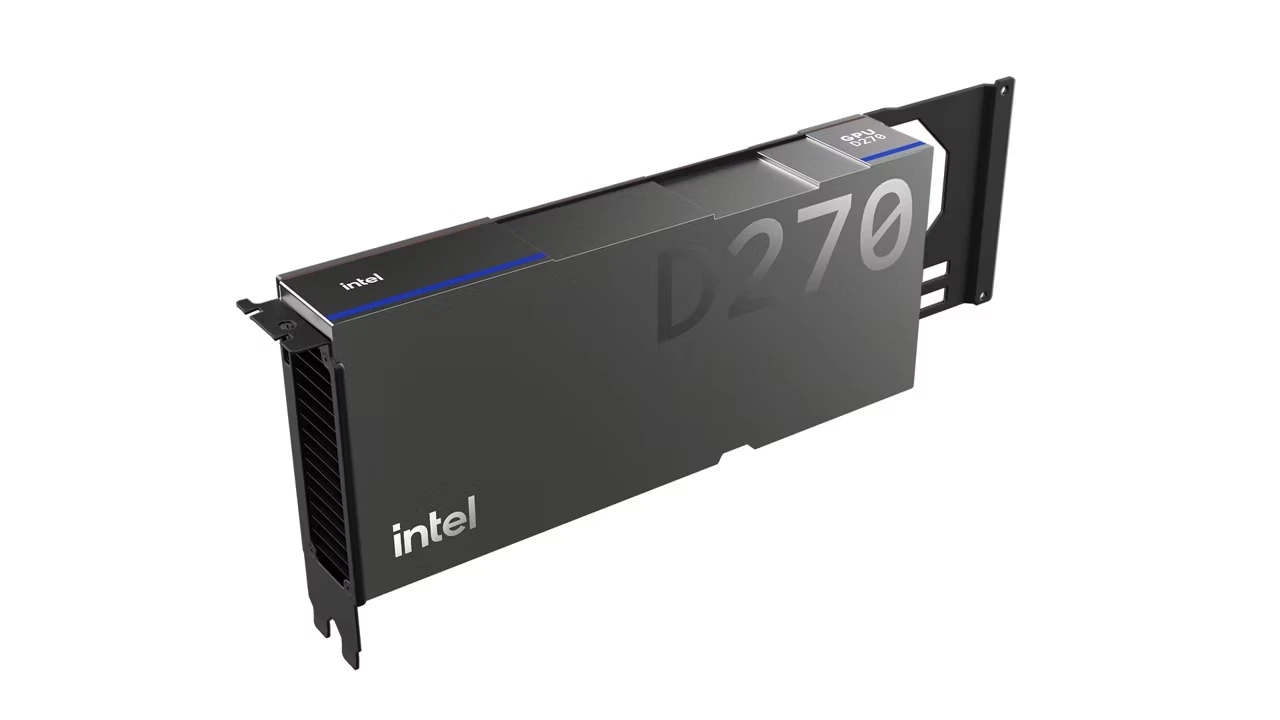
Intel Unveils the GPU D-series for Advanced AI Inference
Transforming Data Center Performance
During the 2026 OCP Global Summit, Intel officially announced a major rebranding. The company renamed its Crescent Island data center inference GPU to the Intel GPU D-series. This advanced hardware utilizes the robust Xe3P architecture. Consequently, the Intel GPU D270 emerges as the very first product in this innovative lineup.
Unpacking the Intel GPU D270 Specifications
The impressive Intel GPU D270 features 32 distinct Xe cores alongside 256 XMX engines. Furthermore, this powerful chip delivers exceptional FP8 compute performance and memory capabilities. It supports up to 480GB of cutting-edge LPDDR5X memory. This configuration achieves an astonishing memory bandwidth of 1.5TB/s. Additionally, the entire card consumes exactly 350W of power. Engineers designed it using the standard PCIe AIC form factor. Thus, it fully supports modern PCIe Gen5 specifications while easily allowing for traditional air-cooling solutions.
Scaling for Massive AI Workloads
Intel specifically engineered the D-series for large language models and extensive context workloads. It also excels at managing concurrent inference services. Remarkably, a single card smoothly supports 300-billion parameter models. Meanwhile, an eight-card system effortlessly handles massive 1-trillion parameter models. The primary target applications include multi-tenant AI services and sophisticated robotics. Ultimately, it caters perfectly to various latency-sensitive workloads across the tech industry.
Next-Generation Xeon Rack Designs
Moreover, Intel collaborated closely with strategic partners to showcase novel rack designs. These advanced setups heavily utilize powerful Xeon processors. Specifically, select configurations featuring the Xeon 6+ architecture can scale massively. They successfully expand to accommodate over 46,000 CPU cores per rack. As a result, these extreme density solutions demand a staggering power draw of 133.45 kW.