
Google Unveils Gemini 4 Argon: A Leap in AI Capabilities
Google officially unveiled its Gemini 4 Argon model yesterday, September 30. The tech giant proclaims it as their most sophisticated AI system yet. However, this powerful tool remains unavailable to the general public currently.
Strategic Positioning and Focus
Regarding its strategic positioning, this flagship model represents Google’s pinnacle of innovation. It focuses heavily on extensive software engineering processes. Furthermore, it prioritizes enterprise knowledge workflows and robust cybersecurity defenses. Consequently, officials report record-breaking performances in real-world software engineering assessments. It also tied for first place in rigorous cybersecurity benchmarks. Moreover, it leads the industry in specialized tasks, including complex finance and legal operations.
Expanded Output Capabilities
In terms of capabilities, the system boasts a remarkable output ceiling. It can generate approximately one million tokens in a single prompt. This vastly exceeds the previous limit of 64,000 tokens. Therefore, it perfectly handles massive codebases, lengthy documents, and complex assignments.
Tulsee Doshi, the product leader for Google DeepMind, shared her insights. “Argon stands as an extraordinarily versatile model,” she stated. “It possesses cutting-edge capabilities across a multitude of distinct domains.”
Benchmark Dominance
This formidable new system achieves state-of-the-art results in specific evaluations. Moreover, it consistently outperforms rival OpenAI’s frontier model, GPT-6 Astra, across several crucial metrics.
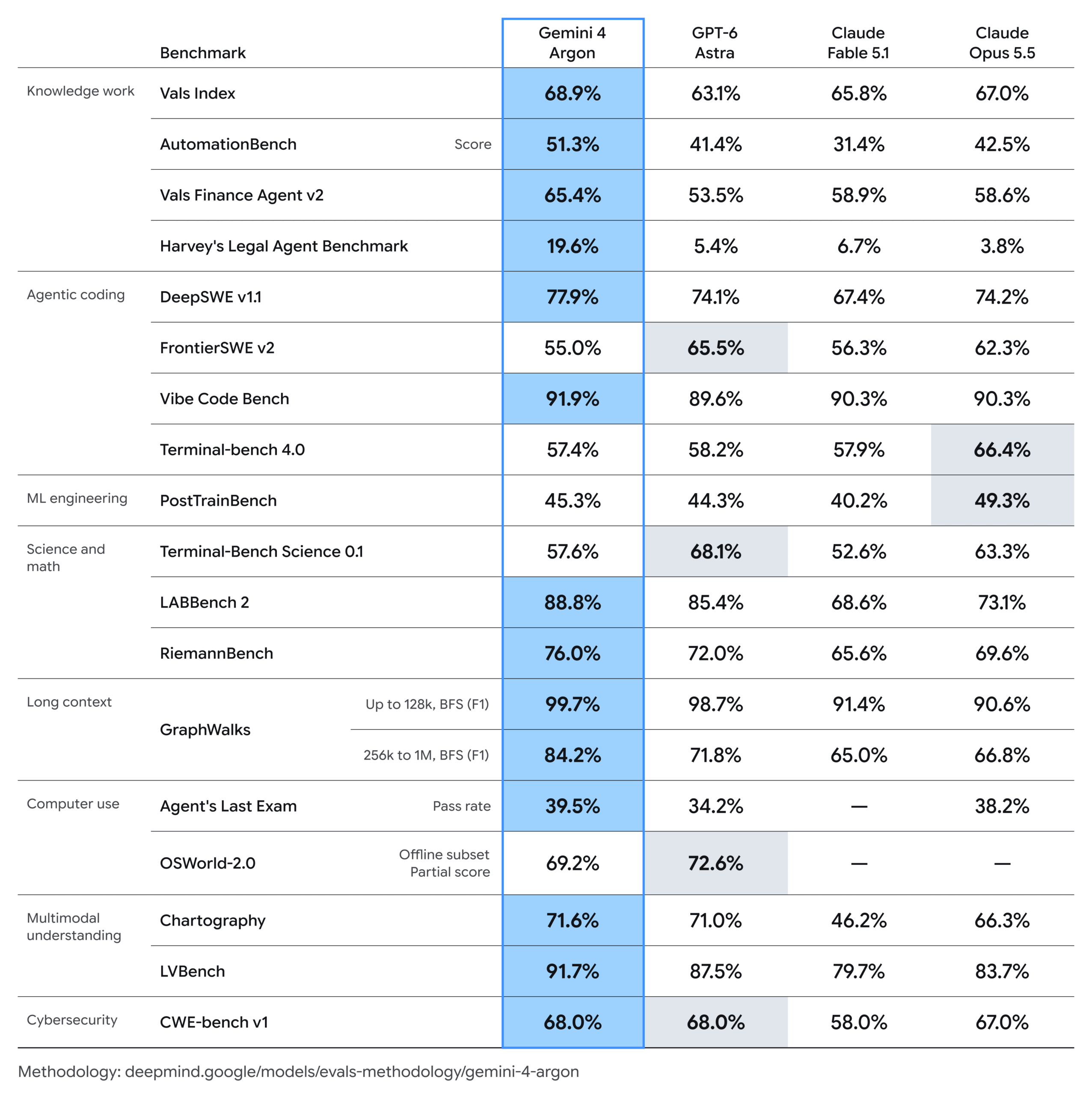
When evaluating raw performance, Google claims an impressive DeepSWE v1.1 score of 77.9 percent. In contrast, Claude Opus 5.5 secured 74.2 percent. Meanwhile, GPT-6 Astra trailed slightly at 74.1 percent.
Advanced Security Protocols
Furthermore, Google engineers meticulously trained the system for superior security defense. They designed it to be exceptionally proficient in thwarting digital threats. This marks a profound improvement over the earlier 3.8 Flash Cyber iteration. For instance, the CWE-bench v1 test evaluates a model’s ability to patch vulnerabilities. During this rigorous assessment, the new system tied for first place with a stellar 68 percent score.
Detailed Performance Metrics
Below are the detailed benchmark results comparing the new system against top competitors:
- DeepSWE v1.1: Achieved 77.9 percent, securing the top position for real-world software tasks.
- Vibe Code Bench: Scored 91.9 percent, leading competitors in translating natural language into code.
- CWE-bench v1: Reached 68 percent, tying for first in autonomously fixing software vulnerabilities.
- AutomationBench: Attained 51.3 percent, ranking first for automated execution across business software.
- LVBench: Scored 91.7 percent, establishing the standard for lengthy video comprehension.
- GraphWalks (0 to 128K): Achieved 99.7 percent, demonstrating exceptional long-context graph reasoning.
- GraphWalks (256K to 1M): Secured 84.2 percent, displaying a clear advantage in ultra-long contextual logic.
- Agent’s Last Exam: Reached 39.5 percent, decisively surpassing GPT-6 Astra’s 34.2 percent.
- Vals Index: Attained 68.9 percent, outperforming both GPT-6 Astra and Claude Opus 5.5.
- Intelligence Index: Scored 53, perfectly matching GPT-6 Astra in multifaceted synthetic intelligence.
Phased Distribution Strategy
Regarding distribution strategy, the tech giant plans a meticulously phased rollout. The initial phase operates through an initiative dubbed the Fairwind Program. This exclusive program provides access to trusted cybersecurity defenders. Additionally, it participates in the United States government’s voluntary pre-release model evaluation process.
Pricing and Availability
Finally, let us examine the upcoming pricing structure. Google intends to grant initial access strictly to premium API clients and Google AI Ultra subscribers. Eventually, they will expand availability to broader enterprises and everyday consumers.
Initially, input tokens will cost two dollars per million. Later, this price will double to four dollars. Conversely, output tokens launch at ten dollars per million. This will eventually rise to twenty dollars. However, cached input tokens will generously receive a 95 percent discount off the standard input rate.