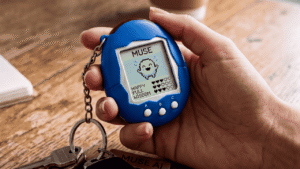

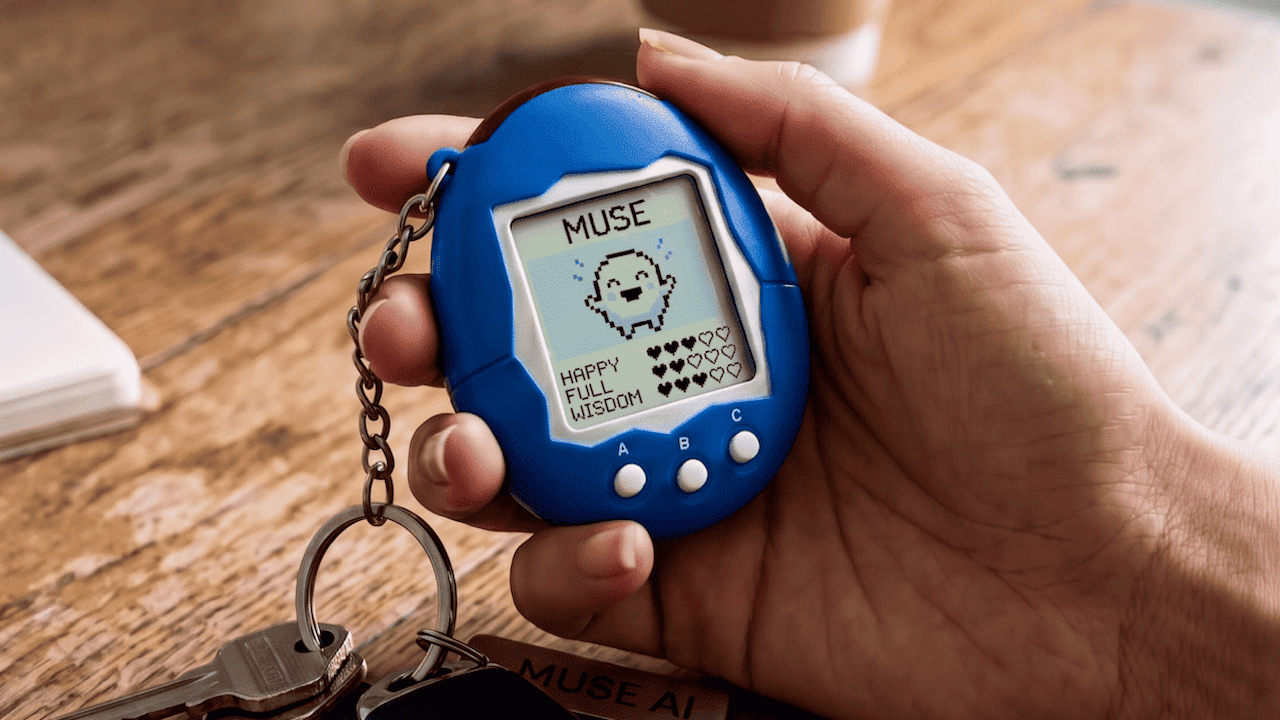
Relying on a smartphone to converse with artificial intelligence may soon become an archaic necessity. Meta has ingeniously condensed its personal agent, Muse, into a pocket-sized keychain replete with a display, bearing a striking resemblance to a contemporary Tamagotchi. The corporation unveiled the Meta Muse Charm device at the Meta Connect 2026 conference, with this novel gadget anticipated to grace retail shelves in time for the December holiday season.
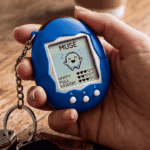
Dimensionally comparable to an AirPods charging case, the Muse Charm seamlessly affixes to a keyring. Its anterior facade features an approximate two-inch tactile display showcasing an animated Muse persona, while a biometric fingerprint sensor initiates vocal interactions. The apparatus boasts 5G connectivity and facilitates real-time vocal discourse, effectively metamorphosing the AI agent into a standalone physical artifact that liberates the user from the incessant need to retrieve a smartphone.
Beneath this endearing digital facade lies a profoundly sophisticated framework. Muse possesses the capability to interface with interconnected services, execute user directives, orchestrate schedules, and navigate web platforms. Patrons can meticulously tailor the persona, customizing both its visual aesthetics and vocal idiosyncrasies. Consequently, any parallel to a Tamagotchi abruptly concludes at its diminutive stature, interactive screen, and virtual protagonist.
Meta has yet to divulge the precise proportion of computational processing that will transpire natively on the Charm. Given that the foundational Muse architecture relies upon a dedicated cloud infrastructure dubbed Muse Secure VM, this compact gadget will presumably serve primarily as a perpetual interface to the agent. The enterprise has also remained reticent regarding the battery capacity, definitive technical specifications, and forthcoming retail pricing.
The initiative presently resides at a nascent developmental juncture. Mark Zuckerberg disclosed that the company has assembled merely a handful of prototypes and is concurrently deliberating over chassis materials and the ultimate internal configuration. Notwithstanding its unfinalized design, Meta presented the Muse Charm, alongside the biggest news from Connect 2026, as an innovative, pocketable conduit to remain perpetually tethered to one’s personal agent, projecting an inaugural delivery schedule slated for December.
Amplifying accessibility to Muse simultaneously escalates the gravity of any intrinsic vulnerabilities within the agent itself. A mere few days prior, security researchers unearthed a zero-day exploit within the macOS iteration, enabling localized malicious software to intercept vocal queries and usurp permissions previously granted to the assistant. Following the public disclosure, Meta swiftly deployed a remedial patch.
Crucially, not every action attributed to Muse is exclusively executed by the algorithm. During rigorous internal trials, Meta experimented with a paradigm wherein specific telephonic errands were delegated to human operators within a call center. Corporate personnel engaged in fervent debate concerning the degree of transparency required when such a transition occurs.
The Charm will constitute merely a singular method of carrying Muse on one’s person. The corporation is concurrently adapting the agent for smart eyewear integration, having recently introduced the Ray-Ban Meta Audio – a device bereft of a camera but generously equipped with microphones and vocal functionalities. Ultimately, Muse is incrementally evolving from a standalone application into a unified, omnipresent ecosystem, accessible via smartphones, augmented reality spectacles, and this dedicated pocket-sized contrivance.