Four Tesla V100 GPUs Outperform M5 Ultra in AI Benchmark
Testing the Tesla V100 Configuration
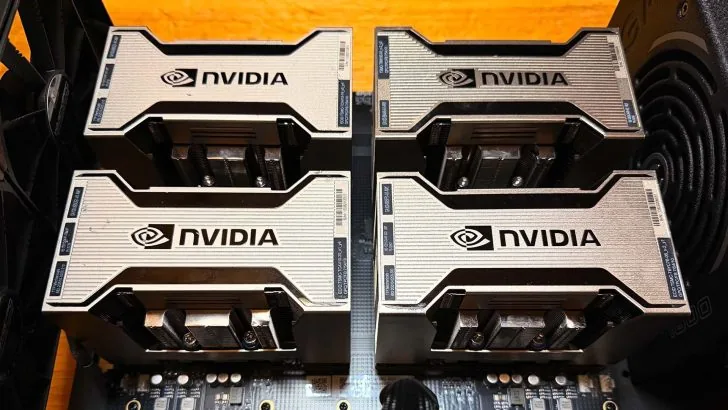
The YouTube channel Jun Yamog published an insightful video on October 12. This video demonstrated a unique hardware test. Specifically, the creator mounted four Tesla V100 GPUs onto a custom NVLink carrier board. Consequently, the long-prompt processing speed in the Qwen3.8-Flash-Next benchmark showed remarkable results. The setup proved 230% faster than an M5 Ultra device. Furthermore, it operated 40% faster than two DGX Spark units.
Understanding the Hardware Components
Publicly available data reveals essential details about this technology. Nvidia originally introduced the Tesla V100 data center GPU in 2017. Engineers built this powerful hardware on the Volta architecture. Therefore, professionals frequently utilize it for demanding AI training and inference tasks. Its 32GB variant features robust HBM2 memory. Additionally, a massive memory bandwidth of 900GB/s facilitates the rapid reading of large model parameters.
The Power of NVLink Technology
NVLink serves as Nvidia’s premier high-speed GPU interconnect technology. System builders use it to transmit data directly between multiple GPUs. Compared to standard PCIe communication, NVLink successfully eliminates severe interconnection bottlenecks. As a result, developers heavily deploy it across multi-GPU servers and advanced AI computing clusters.
Custom Carrier Board Modifications
This specific NVLink carrier board delivers an impressive 300GB/s of bandwidth. It also incorporates six distinct NVLink 2.0 connections. To accommodate four independent GPUs, the tester modified an Nvidia A100 heatsink. This clever modification successfully dissipates the 300W power consumption of each V100 unit. Finally, a standard PCIe x8 interface connects the entire array to the main carrier board.
Benchmark Results and Comparisons
The creator conducted extensive tests using the 4-bit quantized Qwen3.8-Flash-Next model. The primary comparison subjects included two DGX Spark machines. These machines featured 128GB of LPDDR5X unified memory. Additionally, the evaluation included a modern Mac Studio device powered by the M5 Ultra chip.
Analyzing Prompt Processing Speeds
During the long-prompt processing test, the four V100s performed 40% faster than the DGX Spark cluster. Moreover, they completely outpaced the M5 Ultra by 230%. The tester noted a crucial point about this massive performance gap. Specifically, the deficit against Apple Silicon might partially stem from insufficient software optimization.
In the short-prompt processing evaluation, the V100 cluster maintained a steady 40% speed advantage over the DGX Spark. Similarly, it operated 163% faster than the M5 Ultra. These compelling results demonstrate a fascinating reality. Older data center GPUs still possess exceptional throughput capabilities for specific inference workloads.
Token Generation Performance
For the short-prompt token generation test, the four V100s achieved a stellar 100.6 tokens per second. Consequently, they ran 121% faster than the two combined DGX Spark units. Meanwhile, the M5 Ultra recorded a modest score of only 44.5 tokens per second.